- Home
- Free Garden Printables
- Seed Starting Chart
Seed Starting Chart — Free Printable
for Every Vegetable in Your Garden
 Free printable seed starting chart. This quick guide provides the information you need for most common garden vegetables.
A good seed starting chart takes the guesswork out of one of the most important decisions in the vegetable garden — when to start each crop.
- Start seeds too early and you end up with overgrown seedlings that struggle when they finally go outside.
- Start too late and you lose weeks of the growing season.
A reliable chart gives you the right timing for every vegetable, calculated from your last frost date.

Download our free printable seed starting chart below.
It covers all the major vegetable crops with indoor start dates, direct sow dates, and transplant windows.
Print it, laminate it, and keep it near your seed boxes.
It will be one of the most-used and helpful reference tools in your garden from now on.
How to Use Your Seed Starting Chart

Your seed starting chart works backward from a single date — your average last spring frost date.
Every timing recommendation on the chart is calculated from that date.
Before you use the seed starting chart, you need to know your frost date for your specific location.
If you do not know your frost date, use our free Zone Finder tool.
Enter your state and region and it will give you both your last spring frost date and your first fall frost date — the two most important dates in any vegetable gardener's calendar.
Once you have your last frost date, you are ready to use the seed starting chart.

- To use the seed starting chart, find your last frost date on the calendar.
- Then count backward by the number of weeks listed for each crop.
If the seed starting chart says to start tomatoes six to eight weeks before last frost, and your last frost is May 15, you should start tomato seeds indoors between March 20 and April 1. It is that straightforward.
The seed starting chart does all the math — all you need is your date.
- Zone Finder — find your last frost date and first frost date before using the seed starting chart
Which Vegetables to Start Indoors

- Not every vegetable goes on the indoor section of the seed starting chart.
- Some crops must be started indoors to have any chance of ripening in a short growing season.
- Others grow so quickly that starting them indoors is a waste of effort. The seed starting chart makes this clear at a glance.
The vegetables that benefit most from an indoor start are the long-season warm-season crops.
- Tomatoes need six to eight weeks indoors before the last frost date.
- Peppers and eggplant need eight to ten weeks — they are the slowest of all common vegetables and should be the first seeds you start each year.
- Celery and onions started from seed also need eight to ten weeks indoors.
Medium-term indoor crops on the seed starting chart include broccoli, cabbage, cauliflower, kale, and Brussels sprouts.
These brassicas need four to six weeks indoors and go out before the last frost date — they can handle light frost and actually grow better in cool weather.
Starting them indoors gives you larger, better-established transplants than direct sowing provides.
Cucumbers, squash, melons, and pumpkins appear on the seed starting chart as short-term indoor starts — just two to three weeks before the transplant date.
Their roots are sensitive to disturbance.
Starting them in individual peat or coir pots that go straight into the ground without disturbing the roots is the best approach.
Seeds to Direct Sow —
The Other Half of the Seed Starting Chart

A complete seed starting chart covers direct sowing as well as indoor starts.
Many vegetables grow better when sown directly in the garden rather than started indoors and transplanted.
Root vegetables — carrots, beets, parsnips, turnips, radishes — must be direct sown.
Their roots do not tolerate transplanting and will fork, twist, or fail if you try. The seed starting chart shows when to direct sow these crops based on soil temperature and your frost date.
Beans, peas, corn, and most salad greens are also best direct sown.
Peas go in the earliest — often four to six weeks before the last frost date, as soon as you can work the soil.
Beans and corn wait until after the last frost date when the soil has warmed.
Radishes can be sown almost anytime and are one of the fastest crops in the garden — a useful gap-filler between slower crops.
The seed starting chart makes the distinction between indoor starts and direct sow crops clear so you are never trying to transplant something that would rather be in the ground from the beginning.
Hardening Off — The Step Between
the Chart and the Garden

Every seed starting chart includes transplant dates as well as indoor start dates.
Between starting seeds indoors and planting them outside is an essential step that gardeners sometimes skip — hardening off.
- Hardening off means gradually exposing indoor seedlings to outdoor conditions before planting them permanently.
- Seedlings grown indoors under lights or on windowsills are soft and unaccustomed to outdoor sun, wind, and temperature fluctuation.
- Set them outside suddenly and many will sun-scald, wilt, or die even on a mild day.
- Harden off seedlings over seven to ten days.
- Start with two hours in a sheltered, partly shaded spot.
- Increase the time outdoors each day.
By the end of the hardening period, leave them out overnight if temperatures allow.
Seedlings that have been properly hardened off according to the seed starting chart timeline are noticeably sturdier than those that have not — they establish faster, resist stress better, and start producing sooner.
Using the Seed Starting Chart for Fall Planting

A seed starting chart is not just for spring. The same backward-counting principle applies to fall planting, using your first fall frost date instead of your last spring frost date.
Brassicas, — broccoli, kale, cabbage, and Brussels sprouts — planted in late summer for fall harvest , need to be started indoors in midsummer and transplanted out in time to mature before hard frost arrives.
The seed starting chart shows how many weeks before your first fall frost each crop needs to go in the ground, and you count backward from there to calculate your indoor start date.
Fall planting is one of the most underused strategies in the home vegetable garden.
Crops started in midsummer and harvested in fall often outperform their spring counterparts — cooler temperatures improve the flavor of most brassicas and leafy greens, and pest pressure is typically lower in fall than in spring.
More Free Vegetable Garden Printables

Our seed starting chart is one of several free printables available on this site.
Our vegetable planting calendar gives you month-by-month planting windows for every major crop.
Our vegetable garden journal is the right place to record your actual start dates alongside the chart dates — comparing the two across seasons reveals the small timing adjustments that make each year better than the last.
- Vegetable Planting Calendar — free printable zone-specific planting windows for all major vegetable crops
- Free Vegetable Garden Journal — free printable journal to record your actual start dates alongside seed starting chart timing
- Vegetable Garden Worksheets — free printable planning worksheets and garden diary pages
- Zone Finder — find your frost dates before using the seed starting chart
- Seasonal Vegetable Garden — complete guides to spring, summer, fall, and winter growing
- Free Vegetable Garden Printables — all our free downloads in one place
Farmer's Almanac — Seed Starting Chart by Zip Code
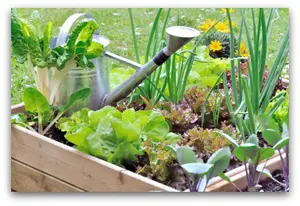
 A small sunny backyard can have a raised bed vegetable garden.
For a customizable online seed starting chart based on your zip code — showing specific indoor start dates, direct sow dates, and transplant windows for your exact location — the Farmer's Almanac at farmersalmanac.com has an excellent interactive seed starting tool that complements our free printable seed starting chart.
- Farmer's Almanac — Seed Starting Chart — interactive seed starting chart with indoor start dates, direct sow dates, and transplant windows calculated by zip code
Return to our Free Vegetable Garden Printables hub for all our free downloadable charts, calendars, planners, and worksheets.
- Free Vegetable Garden Printables — all our free downloadable garden charts, planners, calendars, and worksheets
Recent Articles


-
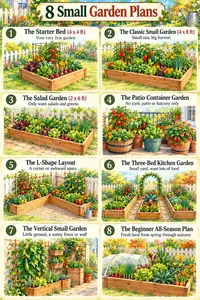
Small Vegetable Garden Plans: 8 Layouts That Maximise Space
Oct 08, 26 10:41 AM
 Small vegetable garden plans are some of the most searched and most valuable resources in home food growing.
 -
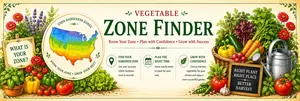
USDA Zone Finder - Find Your Vegetable Planting Dates | Vegetable-Gardening-Online.com
Oct 07, 26 03:53 PM
 Find your USDA hardiness zone, last spring frost date, and first fall frost date by state and region. Free interactive zone finder from Vegetable-Gardening-Online.com.
 -
Interactive Vegetable Garden Planner | Vegetable Gardening Online
Oct 07, 26 02:29 PM
Design a vegetable garden with correctly scaled plant spacing, companion flowers, drag-and-drop placement, and a printable plan. -
Free Printable Garden Stationery: Gardening Letter Paper & Note Cards
Oct 07, 26 12:48 PM
Free printable garden stationery: watercolor letter paper, lined and unlined, plus folded note cards with garden, fall, and Christmas scenes. Print at home. -
Free Preschool Vegetable Garden Cut and Paste Activities
Oct 07, 26 12:43 PM
 Free preschool vegetable garden cut and paste activities for ages 3-4. Build your own backyard, container, or seed packet garden scene, and sticker sheets.
 -
Planning a Vegetable Garden: Layouts, Raised Beds, Containers & More
Oct 06, 26 07:44 PM
 Planning a vegetable garden? Start here: layouts, raised beds, containers, square foot gardening, free planning tools, and tips to avoid beginner mistakes.
 -
How to Start a Vegetable Garden: 10 Easy Steps for Beginners
Oct 06, 26 04:38 PM
 How to start a vegetable garden in 10 easy steps: pick a sunny spot, choose raised beds or containers, prepare the soil, and grow easy vegetables.