- Home
- Free Garden Printables
- Free Vegetable Garden Journal
Free Vegetable Garden Journal —
Download and Print Your Copy Today

A free vegetable garden journal is one of the most practical tools a home gardener can have.
Every experienced gardener knows the feeling — standing in the garden in midsummer, unable to remember exactly when the tomatoes were planted, which variety of squash is in the east bed, or what that pest was that destroyed the broccoli last August.
A good vegetable garden journal solves all of that. It becomes your permanent record of everything that worked, everything that did not, and everything you want to do differently next season.
Our free vegetable garden journal is designed specifically for home vegetable gardeners.
The pages are beautiful enough to display on a kitchen shelf and practical enough to carry into the garden.
Every section is designed around the real questions and records that matter most to someone growing their own food.
Download it free, print it at home, and keep it in a binder or have it spiral bound at your local copy center for a journal that looks and feels like something you will actually use year after year.
Choose the Journal That Fits Your Garden

We offer two versions of the free vegetable garden journal.
The full 16-page journal covers everything from garden goals through seed saving. It is the most complete record-keeping system we offer.
If you want something simpler, our 7-page journal covers the essentials: planting dates, harvest tracking, and season notes. It is a quicker way to start if a full journal feels like too much at first.
Both versions work the same way. Print one, keep it where you will see it, and fill it in a little at a time through the season.
You may also choose to download and include individual pages from either journal in your garden journal.
This 7 page journal is for keeping simple basic gardening records:


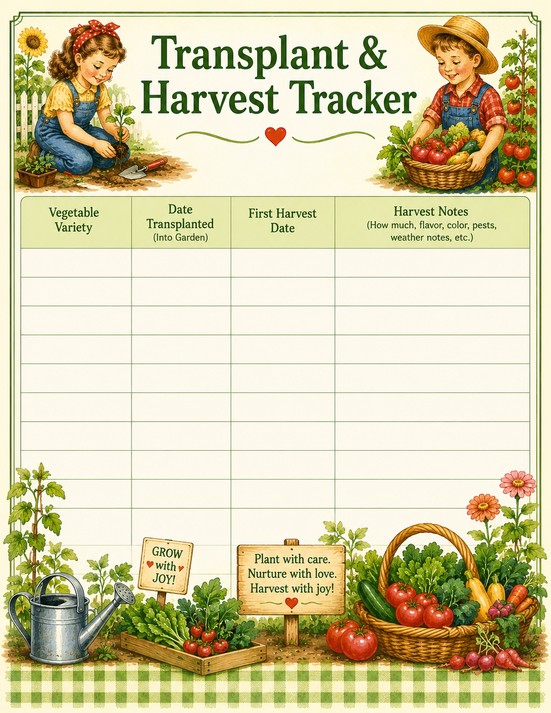 Track transplant and harvest dates side by side to see how each variety performed.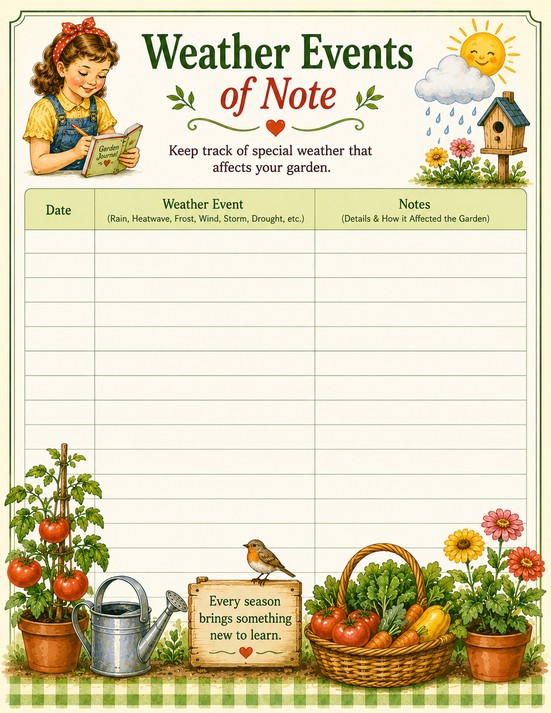
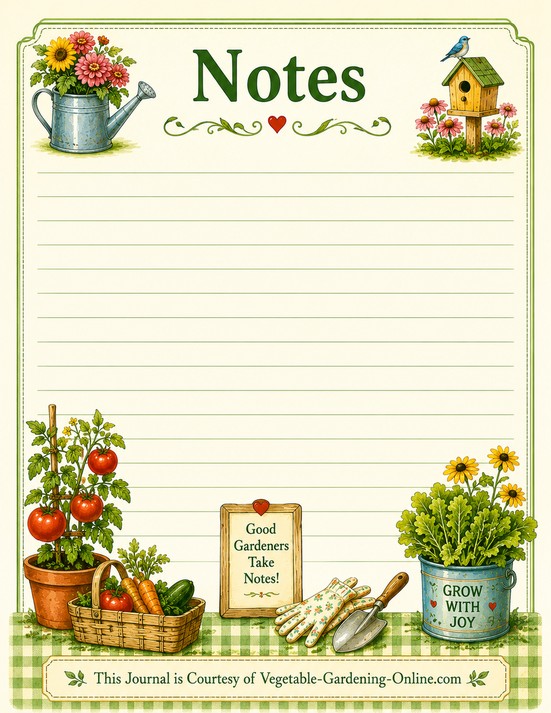

Sample Pages From Our 16 Page
Free Vegetable Garden Journal
This journal is for keeping more detailed records of your garden:


Before downloading, take a look at what our free vegetable garden journal looks like.
The pages are illustrated with the beautiful garden imagery you will find throughout the Kids Garden Club and Vegetable Gardening Online collections — warm, detailed, and genuinely lovely to use.
A vegetable garden journal does not need to be a plain notebook.
When the pages are beautiful, you are more likely to sit down and fill them in — and more likely to keep doing it season after season.
What Is Inside the Free Vegetable Garden Journal

Our free vegetable garden journal includes everything a home vegetable gardener needs to track a complete growing season from first seed order through final harvest.
Here is what you will find inside:
The journal opens with a garden overview page where you record your garden dimensions, growing zone, first and last frost dates, and your goals for the season.
This is the page you return to year after year to see how your plans and ambitions have evolved.
Planting record pages give you space to record every vegetable you plant — the variety name, planting date, seed source, spacing, and location in the garden.
A complete planting record means you will never again forget which tomato variety produced so well two summers ago.

Weekly garden notes pages give you space to record observations through the growing season — what is thriving, what is struggling, what the weather has been doing, and what you noticed on your last walk through the garden.
These notes become invaluable the following spring when you are planning the new season.
 Garden notes can be extremely helpful from year to year when planning your next year's vegetable garden.
We also provide a handy garden shopping guide, and supply list page. This is helpful for planning a garden budget, when shopping for seeds, plants, and supplies.

Harvest tracker pages let you record what you harvest and when — building a picture of your garden's productivity over the years and helping you decide how much of each vegetable to plant next season.

Pest and disease record pages help you track what problems appeared, when they appeared, and what you did about them.
Knowing that cucumber beetles arrived in the second week of July two years running tells you exactly when to put up your row covers next season.

How to Use Your Free Vegetable Garden Journal

Using a free vegetable garden journal effectively is simpler than most gardeners expect. You do not need to fill in every page perfectly.
You do not need to write long detailed entries. Even a few notes — planting dates, first harvest dates, anything that surprised you — are enough to make the journal genuinely useful the following season.
Review your journal in late winter, before you order seeds.
Look for the varieties that performed best and plan to grow them again.
Look for timing adjustments that would have helped — seeds started a week earlier, transplants set out before the heat arrived.
Print the complete free vegetable garden journal once and keep it in a three-ring binder on your potting bench or kitchen counter.
Some gardeners prefer to have their journal spiral bound at a local copy center for a more polished finished result — this works especially well if you want to give the journal as a gift alongside a packet of seeds or a pair of garden gloves.
Your journal is also the right place to plan crop rotation.
Record which crop grew in each bed every year, and you will always know where to move each plant family next season.
This prevents the disease and pest buildup that comes from planting the same crop in the same spot year after year.

Carry the journal into the garden with you when you do your weekly walk-through. Jot notes while you are looking at the plants rather than trying to remember later what you observed.
The most useful entries are often the shortest — a date, a variety name, a simple observation. Over time those small notes accumulate into an invaluable record of your garden's particular rhythms, strengths, and tendencies.

The free vegetable garden journal works best when used alongside our free seed starting chart — recording when you start seeds indoors, when you transplant, and when you harvest creates a complete picture of each variety's performance in your specific location and climate.
After three seasons of records you will know your garden in a way that no book or website can teach you.
Why Keep a Vegetable Garden Journal?

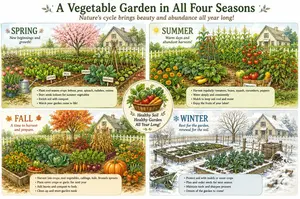
I have been growing, or helping with growing, vegetables since 1961 in the Willamette Valley of Oregon. In 1961 I was helping (sometimes unwillingly!) in my parents vegetable garden.We lived on a farm, and our garden was supposed to look something like the image above. It was a lot of work to keep the weeds under control, and to harvest all the vegetables at the best time, and then to help with the canning and freezing of all the produce for winter use.
The most useful thing I have learned in all those years is that the garden teaches you something new every season — but only if you write it down. Memory fades. Notes do not.
A free vegetable garden journal keeps that knowledge organized and accessible.
It tells you which varieties performed best in your micro-climate, which pest problems recur on the same schedule every year, when your particular soil warms enough for direct sowing, and which companion plantings made a real difference.
This is personal, local, specific knowledge that no general gardening book can give you. It comes from your garden, your hands, and your years of paying attention.
A journal only works if it stays simple enough that you will actually make use of it. Date, crop name, variety, what you did, and one observation is enough.
Five minutes a week is all it needs to take.

Beginning gardeners find the free vegetable garden journal especially valuable because it accelerates the learning curve dramatically.
What might take ten years of trial and error to accumulate becomes visible within two or three well-documented seasons.
The gardener who keeps records gets better faster than the gardener who relies on memory alone.
Printing and Assembling Your
Free Vegetable Garden Journal
 Keep your Vegetable Garden Journal where you have easy access to it when planning , caring for, harvesting, or preserving your vegetable garden.
Printing and assembling your free vegetable garden journal takes about fifteen minutes. Here is the simplest approach.
Print on standard letter-size paper — 8.5 by 11 inches. For a sturdier journal that holds up to outdoor use, print on 24-pound paper rather than standard 20-pound copy paper.
The heavier paper feels noticeably more substantial and resists moisture better when carried into the garden.
For a journal you will use daily through the season, consider printing a few extra copies of the pages you will use most — the weekly notes pages and harvest tracker pages in particular.
You can print as many copies of any page as you need since the free vegetable garden journal is yours to use however works best for your garden.
Assemble the printed pages in a three-ring binder with tabbed dividers for each section.
An inexpensive clear-front binder lets you display the cover page through the front — which makes the finished journal look polished and inviting on a shelf.
Alternatively take the printed pages to any office supply store or copy center and have them spiral bound for a few dollars — a spiral-bound free vegetable garden journal lies flat when open, which is ideal for writing in while standing at the potting bench.
More Free Vegetable Garden Printables

Our free vegetable garden journal is part of a growing library of free printable resources at Vegetable Gardening Online.
We also offer a seed starting chart, a vegetable planting calendar, a companion planting chart, a zone finder, an interactive online garden planner, and a full range of free worksheets and planning tools — all free to download.
For additional ideas on what to record in a vegetable garden journal and how to use your records to improve future seasons, visit our vegetable garden journal information page which covers record-keeping strategies in more detail.
For research-based guidance on garden record-keeping, the National Gardening Association at garden.org has excellent resources for home vegetable gardeners who want to grow more intentionally year after year.
- Seed Starting Chart — free printable indoor start dates for every vegetable, pairs perfectly with the journal
- Vegetable Planting Calendar — free printable zone-specific planting calendar for recording alongside journal entries
- Companion Planting Chart — free printable quick-reference chart to include in your garden journal binder
- Vegetable Garden Worksheets — free planning worksheets and garden diary pages
- Free Vegetable Garden Printables — all our free downloads in one place
National Gardening Association —
Garden Record Keeping Resources
For research-based guidance on garden record keeping — including what to track, how to use records to improve crop rotation planning, and how garden journals help you build knowledge specific to your local micro-climate — the National Gardening Association at garden.org has excellent free resources for home vegetable gardeners who want to grow with more intention and accuracy each season.
- National Gardening Association — Learn — research-based vegetable gardening resources including guidance on record keeping, crop planning, and seasonal garden management

Recent Articles


-
How to Grow Cabbage
Sep 15, 26 12:33 PM
 How to Grow Cabbage: The Complete Guide from Seed to Harvest. This complete guide covers everything you need to know about how to grow cabbage.
 -
Easiest Vegetables to Grow: 15 Foolproof Crops for Beginners
Sep 15, 26 09:24 AM
 Easiest vegetables to grow for beginners - with advice on what makes each one easy, how to get started, and which vegetables are harder than they look.
 -
How to Grow Green Beans
Sep 14, 26 07:53 PM
 How to Grow Green Beans: The Complete Guide to Bush and Pole Beans. Green beans are one of the most forgiving crops a beginner can choose.
 -
Seasonal Vegetable Garden
Sep 14, 26 05:38 PM
 Seasonal Vegetable Garden — Growing Food Through Every Season
 -
Overwintering Vegetables: Fall-Planted Crops for Early Spring Harvest
Sep 14, 26 05:35 PM
 Learn about overwintering vegetables like garlic, fava beans, and onions, planted in fall to sit through winter and reward you with an early spring harvest.
 -
Free Vegetable Garden Journal— Printable Downloads for Home Gardeners
Sep 14, 26 01:51 PM
 Download our free Vegetable Garden Journal — choose a full 16-page version or simpler 7-page journal. Track planting, harvest, & garden notes season by season.
 -
Free Vegetable Garden Cut and Paste Activities for Kids Ages 5-7
Sep 12, 26 09:13 PM
 Free printable vegetable garden cut and paste activities for kids ages 5-7. Build your own garden, match seeds to plants, and learn what grows where.