- Home
- Fall Vegetable Container Gardening
Fall Vegetable Container Gardening: Best Crops for Porch, Patio & Balcony

You do not need a backyard to keep harvesting fresh vegetables once summer ends. Fall vegetable container gardening lets you grow a real, productive little garden on nothing more than a porch, patio, deck, or balcony - and the cooler weather actually works in your favor, since most fall crops prefer it that way.
The trick with fall vegetable container gardening is knowing which crops are worth the pot space this time of year, and giving each one a container that is actually big enough for its roots.
Even one container with a parsley plant or two, and some lettuce or chives will be very helpful in your kitchen. It's difficult to use a bunch of parsley from the grocery store before part of it goes bad. When you grow your own, you pick as much as you need at one time, and the remainder keeps growing until you need it.
A tomato that struggled in a small pot all summer is one thing, but a fall crop crammed into an undersized container will bolt, stall, or simply never fill out before the cold arrive

I have grown vegetables in the Willamette Valley since 1961, when I first remember helping my parents in our large vegetable garden.
Then, ours was an in-the-ground garden suitable for freezing and canning vegetables for a family of six. It was a lot of work, and taught me the basics of vegetable gardening.
Since then, I have grown gardens both in raised beds, and in containers, and fall is one of my favorite seasons for pots specifically because you can move them.
A container garden lets you chase the last of the afternoon sun, or pull everything back under an overhang the night a hard frost is forecast - something an in-ground bed simply cannot do.
From Summer Flowers to a Fall Vegetable Garden:
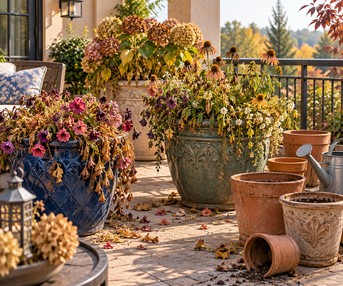 When your summer flowers start to die off, don't let the containers go to waste! Remove the spent flowers, and plant some cool weather vegetables.
Don't toss those spent summer containers just yet.
Once the flowers fade and the blooms turn brittle, the pot underneath is often still perfectly good soil, just waiting for its next job.
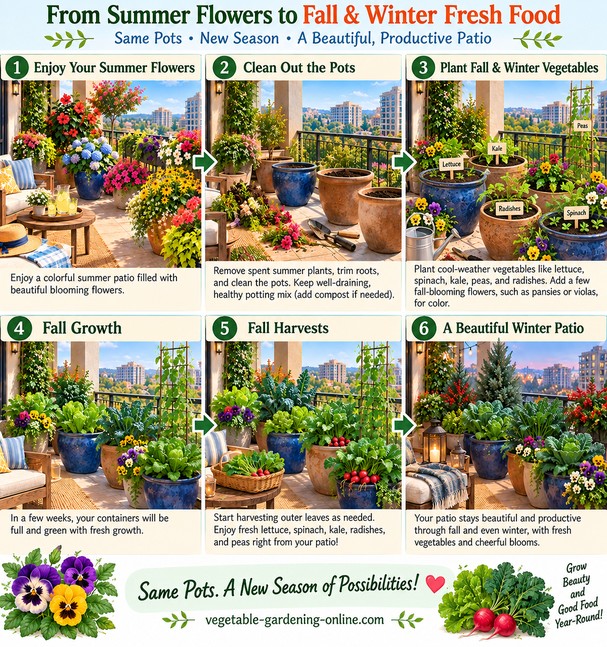
Clear out the dead growth, refresh the soil with a bit of compost, and plant the same container with lettuce, kale, spinach, peas, or radishes instead. Same pot, same spot on the patio, an entirely new season of harvest ahead.
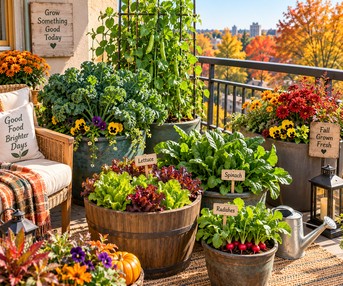 Fall patio container garden with kale, peas on a trellis, lettuce, spinach, and radishes growing in barrels and pots, surrounded by autumn foliage
Best Vegetables for Fall
Vegetable Container Gardening
Not every vegetable belongs in a fall container garden.
Warm-season crops like tomatoes, peppers, and squash are done for the year once nights turn cool, so fall vegetable container gardening focuses on quick-growing, cold-tolerant crops instead.
Lettuce is the easiest possible starting point for fall vegetable container gardening. It grows quickly, tolerates light frost, and actually turns sweeter once the weather cools. A shallow container six to eight inches deep is plenty, since lettuce roots stay close to the surface.
Kale and Swiss chard are two of the best-suited crops for fall vegetable container gardening because they genuinely improve with a bit of cold. Give each plant an eight to twelve inch deep container, or space several plants twelve to sixteen inches apart in a larger planter box.
Spinach thrives in cooler fall temperatures and does well in a container as shallow as six inches, though a slightly deeper pot holds moisture better through Indian summer warm spells.


Radishes are one of the fastest crops you can grow in a fall container garden, often ready to harvest in three to four weeks. A pot just six inches deep is enough, which makes radishes an excellent choice for a narrow window box or rail planter.
Bunching onions and scallions handle cool weather well and take up very little width, so they are easy to tuck into the edges of a larger fall vegetable container gardening setup alongside lettuce or kale.
Herbs like parsley, chives, and cilantro round things out nicely. All three tolerate cool fall weather and grow happily in one to two gallon pots, and they pair well visually and practically with the leafy greens above.
Container Size Guide for Fall Vegetables
| Vegetable | Minimum Depth | Spacing / Notes |
|---|---|---|
| Lettuce | 6-8 inches | Thin to 8-10 inches apart; shallow roots |
| Kale | 8-12 inches | One plant per gallon pot, or 16 inches apart in a planter box |
| Swiss Chard | 10-12 inches | Space plants about 8 inches apart |
| Spinach | 6-8 inches | Thin to 5 inches apart; likes a wider, shallow container |
| Radishes | 6 inches | Thin to 1-2 inches apart; great for window boxes |
| Bunching Onions | 8 inches | Space 2 inches apart; tuck along container edges |
| Herbs (parsley, chives, cilantro) | 6-8 inches | 1-2 gallon pots; pairs well with greens |
Protecting Fall Container Vegetables from an Early Frost

The one thing every fall vegetable container gardening guide should tell you plainly: containers cool down faster than the ground does.
Roots that are safely insulated by soil in an in-ground bed are much more exposed to cold in a pot, so a container crop can suffer frost damage on a night when an in-ground bed of the same vegetable would be just fine.
The upside of fall vegetable container gardening is that you can do something about it.
Watch your forecast, and on a night when a hard frost is expected, simply carry your pots into a garage, covered porch, or against the house under an eave.
Even that small amount of shelter can be the difference between a healthy crop the next morning and a ruined one.
If moving pots is not practical, cluster your containers close together against a south-facing wall, which holds a surprising amount of radiant heat overnight, and cover the group with an old sheet or frost cloth before dark.
Avoid plastic sheeting directly on the leaves, since it transfers cold rather than blocking it!
Most of the crops best suited to fall vegetable container gardening - lettuce, kale, chard, spinach, and radishes - tolerate a light frost just fine on their own.
It is a hard freeze, not the first frost, that you really need to plan around.
Placement, Sun, and Soil
for Fall Container Vegetables
 Fall vegetable container gardens can be grown in a sunny flower bed where there is room for a few containers.
As the days shorten, the sun sits lower in the sky and many spots that were shaded all summer suddenly get useful light.
Walk your porch, patio, or balcony in the early afternoon and take note of where the fall sun actually reaches - it is often not the same spot that worked for your summer tomatoes.
Most fall vegetable container gardening crops are more forgiving of partial sun than summer vegetables are.
Four to six hours of direct light is enough for lettuce, spinach, and kale, which makes fall vegetable container gardening realistic even on a balcony that only gets morning or afternoon sun rather than a full day of it.
Use a fresh bag of potting mix rather than garden soil, which compacts too heavily in a container and drains poorly.
If you are reusing a pot from your summer vegetables, scoop out the old root mass and refresh at least the top third of the soil with new potting mix and a light application of an all-purpose organic fertilizer before replanting.
Pair It With These Related Guides


If you want additional information on what grows well once the weather cools, our fall vegetable garden guide covers the same crops for in-ground beds and raised beds.
It works well alongside this fall vegetable container gardening guide if you have both kinds of space.
For a deeper dive into container gardening in general - soil, drainage, watering routines, and warm-season crops - see our container vegetable gardening guide.
And before you plant anything, check the Zone Finder to confirm your first fall frost date, since that single date drives almost every timing decision in fall vegetable container gardening.
For additional guidance on container vegetable growing backed by university research, Virginia Cooperative Extension publishes a helpful overview of vegetable container gardening principles.
Related guides: Fall Vegetable Garden | Container Vegetable Gardening | Zone Finder
Source: Virginia Cooperative Extension