- Home
- Growing Fruit and Berries
- Growing Red Raspberries
Growing Red Raspberries
in Your Home Garden
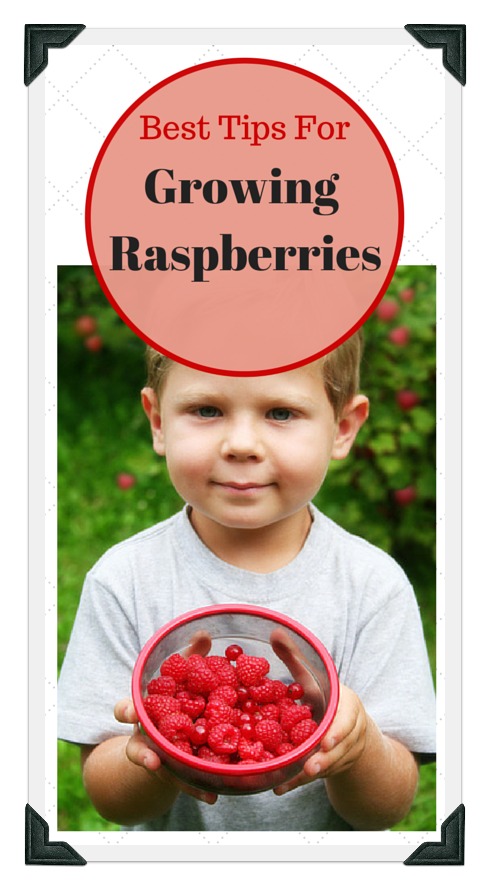
Here are a few easy tips for growing red raspberries in your home garden!
Learn how to plant, care for, and fertilize red raspberry plants when gardening in your backyard.
When growing raspberries, it is important to handle the bare-root plants with care.
Design Your Own Vegetable Garden Layout Using our Free "Vegetable Garden Planner" Software!
Some plants go into such a deep sleep when they become dormant that they can be pulled from the soil, washed clean, and sold with their roots bare.
Red raspberries are the most widely grown and widely loved of all the raspberry types. A well-established red raspberry patch is one of the most productive spaces in the home garden.
This page is part of our Growing Fruit and Berries hub, where you will find guides to strawberries, blackberries, blueberries, gooseberries, and all the best fruits for the home garden.
Growing Fruit and Berries — complete hub for growing strawberries, raspberries, blackberries, blueberries, and gooseberries at home

Raspberries and other brambles are often purchased with bare roots in late winter and early spring, as are many fruit trees and flowering vines.
If you cannot plant your red raspberry plants right away, lay them on the ground and pile about 4 inches of damp soil or compost over the roots so they will not freeze.
Avid gardeners call this procedure, "heeling out".
To get the plants off to a trouble free start, give them a drink of compost tea.
When you lift out the plants a week or so later, do not be surprised if you see threadlike new roots.
This is a welcoming sign that the plants are emerging from their winter slumber at last!
Download Free Garden Planning Worksheets, Garden Diary, Zone Chart, Or Planting Guide

How to Grow Raspberries Using Compost Tea
Compost tea is the most healthful drink you can provide your red raspberry plants.
It delivers a well-balanced supply of important nutrients to plants and helps them to fend off diseases.
To make compost tea:
1 ½ gallons of fresh compost
4 ½ gallons of warm water
- Pour the water into a 5 gallon bucket.
- Scoop the compost into a cotton, burlap, or panty-hose sack.
- Tie it closed and place into the water.
- Cover the bucket and allow it to steep for 3 to 7 days.
- Pour the solution into a watering can or bucket and give your plants a good drink every 2 to 3 weeks.

10 Tips For Growing Red Raspberries

- Planting raspberries in a location that receives full sun is best; however if necessary they can be planted in partial shade.
- Red raspberries prefer a well-drained bed with soil of average fertility.
- The ideal pH is around 6.0.
- The plants will tolerate a soil pH range of 5.5 to 7.0.
- Depending on the variety selected, raspberries grow well in Zones 4 to 8.
- Set out bare-rooted nursery plants in spring.
- Red and yellow growing raspberries produce lots of suckers.
- You can dig the suckers up and plant during the growing season when they have developed roots.
- The canes of black raspberries bend to the ground in autumn, and their tips can take root.
- The new plants that form can be dug up and transplanted the following spring.
Planting Tips for Red Raspberries
- Space plants 2 to 3 feet apart in rows 6 to 7 feet apart.
- Set bare-rooted nursery plants so the crowns are just below the soil surface.
- Transplant suckers to the same depth they were growing previously.
- For propagation, growing raspberries can be reproduced from nursery plants or suckers.
- Raspberries are easily propagated by tip layering, division, root cuttings, and hardwood cuttings.
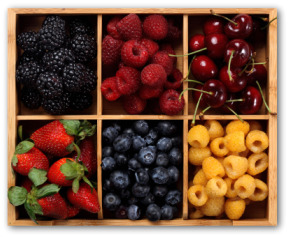 Fresh berries from the garden.
Growing Red Raspberries Tips
 Growing fruit in your garden is a great addition to a healthy diet.
- Raspberries are usually trained on trellis or wires. However, you can also plant them in small clumps or in hedgerows.
- Raspberries are prone to viral and fungal diseases. Start with nursery stock that is certified virus-free.
- Make sure that your newly planted raspberry plants receive adequate water, until the roots are well-established.
Raspberry Mosaic Virus
This plant virus that attacks growing red raspberries should be watched out for.
It is often the reason raspberries grow very slowly, show little vigor, and produce berries that fall apart in your hands.
Leaves of infected plants frequently have curled edges, and may show dark green mottled patterns.
The best strategy is to get rid of an infected berry patch and begin a new one in a different location.
Penn State Extension at extension.psu.edu has a thorough raspberry production guide covering red, black, and purple varieties. It includes soil requirements, fertilizing schedules, pruning methods for each type, and guidance on managing common raspberry diseases.
Penn State Extension — Raspberry Production — comprehensive guide to red, black, and purple raspberry growing including soil, fertilizing, pruning, and disease management

Recent Articles


-
Free Vegetable Garden Printables — Downloads for Every Gardener
Oct 10, 26 11:21 AM
 Browse our complete library of free vegetable garden printables, from planning worksheets and growing charts to kids' activities, all free to download & print.
 -
Free Printable Garden Calendar 2027: 12 Watercolor Months (PDF)
Oct 10, 26 10:30 AM
 Free printable garden calendar for 2027: 12 watercolor garden scenes, a monthly garden task, and room to write. Print the whole year or one month at a time.
 -
Free Printable Gift Tags: Garden, Harvest, and Christmas
Oct 10, 26 10:26 AM
 Free printable gift tags and folded gift cards in watercolor garden designs: flowers, harvest, Thanksgiving, winter, and Christmas. Print at home on cardstock.
 -
Free Printable Garden Stationery: Gardening Letter Paper & Note Cards
Oct 10, 26 10:22 AM
 Free printable garden stationery: watercolor letter paper, lined and unlined, plus folded note cards with garden, fall, and Christmas scenes. Print at home.
 -
Free Printable Return Address Labels: Garden and Christmas
Oct 10, 26 09:26 AM
Free printable return address labels with watercolor garden and Christmas designs. Type your address, pick a picture, and print on Avery 5160 label sheets. -
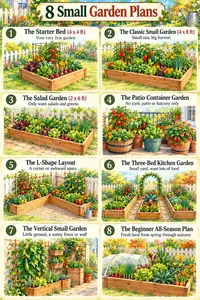
Small Vegetable Garden Plans: 8 Layouts That Maximise Space
Oct 08, 26 10:41 AM
Small vegetable garden plans are some of the most searched and most valuable resources in home food growing. -
USDA Zone Finder - Find Your Vegetable Planting Dates | Vegetable-Gardening-Online.com
Oct 07, 26 03:53 PM
 Find your USDA hardiness zone, last spring frost date, and first fall frost date by state and region. Free interactive zone finder from Vegetable-Gardening-Online.com.