- Home
- Planning A Garden
- Vegetable Garden Planting
Vegetable Garden Planting Times — Complete Guide for Every Crop

Vegetable garden planting times are the single most important piece of information a home gardener needs at the start of each season.
- Plant too early and cold soil and late frosts damage seedlings before they can establish.
- Plant too late and the growing season runs out before crops can mature.
Getting the planting times right for every crop is the foundation of a productive season.
This guide covers everything you need to know about vegetable garden planting times.
It explains how to find your frost dates, how to use soil temperature as your guide, and how to determine the right planting window for every major vegetable crop.
A complete quick reference table gives you vegetable garden planting times at a glance.
Use this page alongside our free Zone Finder and Vegetable Planting Calendar to plan every planting from spring through fa
Start With Your Frost Dates —
The Foundation of Planting Times

Every vegetable garden planting times decision starts with two dates — your average last spring frost date and your average first fall frost date. These two dates define your growing season and anchor every planting window on your calendar.
Your last spring frost date determines vegetable garden planting times for warm-season crops. Tomatoes, peppers, squash, cucumbers, and beans cannot go outdoors until after this date. Cool-season crops — lettuce, peas, broccoli, and spinach — can go in several weeks before this date.

Your first fall frost date anchors your late-season vegetable garden planting times. It tells you how late you can start a crop and still harvest before hard frost arrives. For fall plantings, count backward from your first fall frost date by the number of days each crop needs to mature.
Frost dates are averages, not guarantees. In most areas the last spring frost could arrive a week or two earlier or later than the average in any given year. Experienced gardeners watch the forecast for two weeks or more after their average last frost date and are ready to cover tender plants with a fabric cloth, or move them indoors if possible, if a late frost threatens.
Use our free Zone Finder to look up your last spring frost date and first fall frost date. These are the two dates every vegetable garden planting times decision depends on.
- Zone Finder — find your last spring frost date and first fall frost date, the foundation of all vegetable garden planting times

📅 We've published a new, more complete guide to this topic. See our updated Vegetable Planting Calendar for exact month-by-month planting dates for every common vegetable, organized by your growing zone. Not sure what zone you're in? Use our free Interactive USDA Zone Finder to find your exact frost dates first.
Soil Temperature — As Important as the Calendar
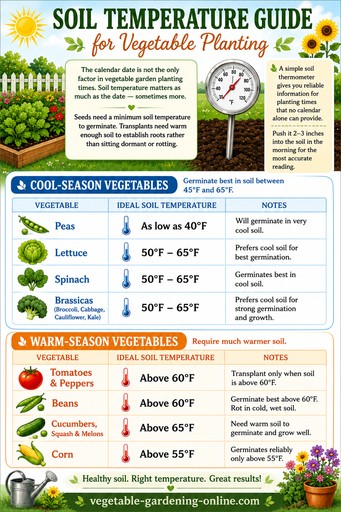
The calendar date is not the only factor in vegetable garden planting times.
Soil temperature matters as much as the date — sometimes more. Seeds need a minimum soil temperature to germinate. Transplants need warm enough soil to establish roots rather than sitting dormant or rotting.
A simple soil thermometer gives you reliable information for vegetable garden planting times that no calendar alone can provide. Push it two to three inches into the soil in the morning for the most accurate reading.
Cool-season vegetables germinate best in soil between 45 and 65 degrees Fahrenheit.
- Peas will germinate in soil as cold as 40 degrees.
- Lettuce, spinach, and most brassicas prefer 50 to 65 degrees.
Warm-season vegetable garden planting times require much warmer soil.
- Tomatoes and peppers prefer soil above 60 degrees before transplanting.
- Beans germinate best in soil above 60 degrees and rot in cold, wet soil.
- Cucumbers, squash, and melons need soil above 65 degrees.
- Corn germinates reliably only above 55 degrees.

Soil temperature guide for vegetable garden planting times:
- Peas and spinach: 40 degrees F minimum, 60 degrees F optimal
- Lettuce and brassicas (cabbage, broccoli, cauliflower family): 45 degrees F minimum, 60-65 degrees F optimal
- Onions and carrots: 45 degrees F minimum, 65 degrees F optimal
- Beans: 60 degrees F minimum, 70 degrees F optimal
- Corn: 55 degrees F minimum, 65-75 degrees F optimal
- Tomatoes and peppers: 60 degrees F minimum, 70 degrees F optimal
- Cucumbers, squash, melons: 65 degrees F minimum, 75 degrees F optimal

Cool Season Vegetable Garden Planting Times

Cool season crops give you the earliest vegetable garden planting times of the year. They tolerate frost, grow best in temperatures between 45 and 70 degrees Fahrenheit, and are often damaged by summer heat.
Peas have the earliest vegetable garden planting times of any common vegetable. Sow peas directly in the garden four to six weeks before your last spring frost date, as soon as the soil can be worked. They prefer cool conditions and their yield declines rapidly when temperatures rise above 75 degrees.
Lettuce, spinach, arugula, and other leafy greens can be direct sown or transplanted two to four weeks before the last frost date. Staggering vegetable garden planting times for lettuce every two to three weeks extends the harvest and prevents all the plants from bolting at once.
Broccoli, cabbage, cauliflower, and kale are best started indoors four to six weeks before their outdoor planting times, then set outside two to four weeks before last frost. They are actually sweetened by light frost and produce their best heads in cool weather.
Carrots and beets are direct sown two to four weeks before last frost. A second sowing in midsummer gives a fall harvest.
Onion vegetable garden planting times are among the earliest of the season. Onions started from seed need eight to ten weeks indoors before transplanting. Onion sets can be planted directly three to four weeks before last frost.
Warm Season Vegetable Garden Planting Times
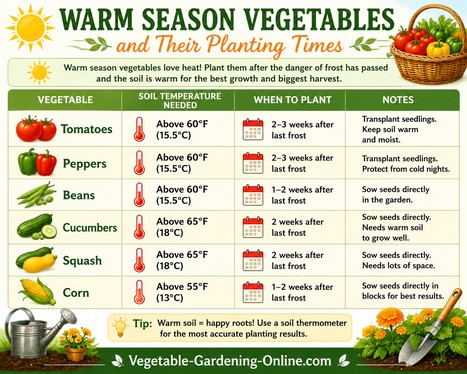
Warm season crops require vegetable garden planting times that fall after your last spring frost date. They are killed by frost and need both warm air and warm soil to perform well. Rushing warm-season planting times is one of the most common beginner mistakes — a tomato transplant set in cold soil a week before last frost will be overtaken within two weeks by one set out on the right date.
Tomatoes: vegetable garden planting times fall one to two weeks after the last spring frost date, when night temperatures stay above 50 degrees and soil is above 60 degrees. Start tomatoes indoors six to eight weeks before transplant time.
Peppers need slightly warmer conditions than tomatoes. Wait until soil reaches 65 degrees. Peppers started indoors eight to ten weeks before outdoor planting times give you the best head start.
Beans are direct sown after all frost danger has passed and soil is above 60 degrees. Staggering bean planting times every two to three weeks through midsummer gives continuous harvests.
Cucumbers, squash, and zucchini go in after last frost when soil is above 65 degrees. If starting indoors, limit it to two to three weeks before outdoor planting time.
Corn planting times begin when soil is above 55 degrees. Plant in blocks for proper pollination. Staggering corn planting times by two weeks extends the harvest.
Sweet potatoes need the warmest vegetable garden planting times of all — two to three weeks after last frost when soil is thoroughly warm.
Vegetable Garden Planting Times —
Quick Reference Table
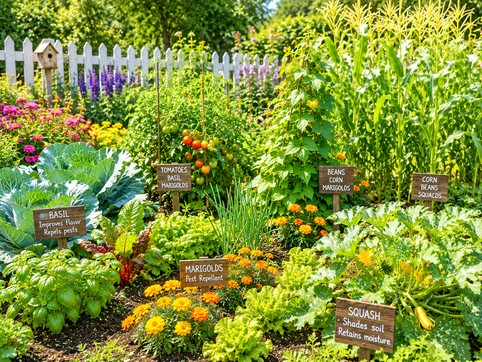
The table below gives vegetable garden planting times for all common crops relative to your last spring frost date. Use it as your quick reference each season. For zone-specific dates based on your location, use our Vegetable Planting Calendar.
| Vegetable | Start Indoors | Set Out / Direct Sow | Notes |
|---|---|---|---|
| Peas | Direct sow only | 4-6 weeks BEFORE last frost | As soon as soil can be worked |
| Spinach | Optional | 4-6 weeks BEFORE last frost | Direct sow preferred |
| Lettuce | 4-6 weeks before transplant | 2-4 weeks BEFORE last frost | Sow in succession every 2-3 weeks |
| Broccoli | 4-6 weeks before transplant | 2-4 weeks BEFORE last frost | Set out as transplant |
| Cabbage | 4-6 weeks before transplant | 2-4 weeks BEFORE last frost | Set out as transplant |
| Cauliflower | 4-6 weeks before transplant | 2-4 weeks BEFORE last frost | Most frost-sensitive brassica |
| Kale | 4-6 weeks before transplant | 2-4 weeks BEFORE last frost | Improved by frost; also plant in fall |
| Onions (seed) | 8-10 weeks before transplant | 4-6 weeks BEFORE last frost | Long lead time required |
| Onions (sets) | — | 3-4 weeks BEFORE last frost | Direct plant sets |
| Carrots | Direct sow only | 2-4 weeks BEFORE last frost | Sow again in midsummer for fall |
| Beets | Direct sow only | 2-4 weeks BEFORE last frost | Sow again in late summer |
| Potatoes | — | 2-4 weeks BEFORE last frost | Plant seed potatoes |
| Asparagus | — | 2-4 weeks BEFORE last frost | Plant crowns; perennial |
| Tomatoes | 6-8 weeks before transplant | 1-2 weeks AFTER last frost | Soil must be above 60 degrees F |
| Peppers | 8-10 weeks before transplant | 2 weeks AFTER last frost | Soil above 65 degrees F preferred |
| Eggplant | 8-10 weeks before transplant | 2 weeks AFTER last frost | Needs warmth to thrive |
| Beans | Direct sow only | AT or 1 week AFTER last frost | Soil above 60 degrees F; sow in succession |
| Corn | Direct sow only | 1 week AFTER last frost | Soil above 55 degrees F; plant in blocks |
| Cucumbers | 2-3 weeks before transplant | 1-2 weeks AFTER last frost | Soil above 65 degrees F |
| Squash / Zucchini | 2-3 weeks before transplant | 1-2 weeks AFTER last frost | Direct sow preferred |
| Pumpkins | 2-3 weeks before transplant | 1-2 weeks AFTER last frost | Allow 90-120 days to mature |
| Melons | 3 weeks before transplant | 2 weeks AFTER last frost | Need long warm season |
| Sweet Potatoes | — | 2-3 weeks AFTER last frost | Plant slips when soil is thoroughly warm |
| Basil | 4-6 weeks before transplant | 2 weeks AFTER last frost | Very frost-sensitive |
Vegetable Garden Planting Times by Zone
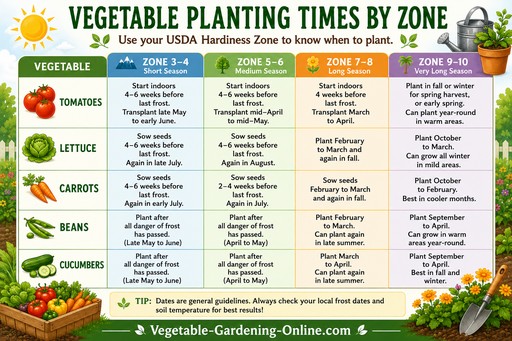
Vegetable garden planting times vary significantly by growing zone. The last frost date that determines your warm-season planting window ranges from January in the warmest zones to May or June in the coldest zones.
In USDA Zones 3 and 4 — northern Minnesota, northern New England, high elevations — vegetable garden planting times for warm-season crops often cannot begin until June. Fast-maturing varieties are essential. Starting long-season crops indoors ten to twelve weeks before transplanting gives them a crucial head start.
In Zones 5 and 6 — the Midwest, Mid-Atlantic, and Pacific Northwest at lower elevations — vegetable garden planting times for cool-season crops begin in March or April. Warm-season crops go in by mid-May to early June. This is the most common zone range for American home vegetable gardeners.
In Zones 7 and 8 — the South, Pacific Coast, and mid-Atlantic — vegetable garden planting times for cool-season crops begin in February or March. Warm-season crops go in by April. Summer heat can be a greater challenge than frost in these zones. Timing cool-season crops for fall often gives better results than spring.
In Zones 9 and 10 — Southern California, the Gulf Coast, and Florida — vegetable garden planting times extend nearly year-round. Cool-season crops thrive in fall and winter.
Use our Zone Finder to confirm your zone and get your specific frost dates.
Succession Planting —
Getting More From Your Planting Times

Succession planting is one of the most effective strategies for getting the most from your vegetable garden planting times. Instead of sowing all of one crop at once, you sow small amounts every two to three weeks. This staggers the harvest so you get a steady supply rather than a glut followed by nothing.
Spreading out vegetable garden planting times works especially well for beans, lettuce, radishes, carrots, beets, and spinach. It also works for corn — planting multiple small blocks two weeks apart extends the harvest across several weeks.
The other key strategy is replacing finished crops immediately. When spring lettuce bolts in summer heat, replace it the same day. When early corn finishes in late summer, sow a quick fall crop or a cover crop. Keeping beds productive through the entire season rather than leaving them empty is one of the hallmarks of an experienced vegetable gardener.

For a customizable vegetable garden planting times calendar based on your zip code, visit the Old Farmer's Almanac at almanac.com/gardening/planting-calendar for exact planting dates calculated from your local frost dates.
- Old Farmer's Almanac — Planting Calendar — vegetable garden planting times by zip code for every major crop
More Vegetable Garden Planting Resources
 Raised bed garden planting times can vary slightly from in-ground gardens, as the soil warms more quickly in a raised bed.
For zone-specific vegetable garden planting times, free printable calendars, and seasonal planning guides, explore these related resources on this site.
- Vegetable Planting Calendar — free printable month-by-month planting calendar with zone-specific dates
- Zone Finder — find your USDA zone, last frost date, and first frost date
- Seed Starting Chart — free printable showing when to start seeds indoors for every vegetable
- Best Time to Plant a Vegetable Garden — seasonal timing guide for getting your garden planted at the right time
- Succession Planting Vegetables — staggered planting for continuous harvests all season
- Seasonal Vegetable Garden — spring, summer, fall, and winter growing guides
- Planning a Vegetable Garden — complete hub for vegetable garden planning
Return to our Planning a Vegetable Garden hub for complete guides to garden design, layout, raised beds, containers, and planning tools.
- Planning a Vegetable Garden — complete hub for garden design, layout, raised beds, containers, and planning tools

Recent Articles


-
How to Grow Cabbage
Sep 15, 26 12:33 PM
 How to Grow Cabbage: The Complete Guide from Seed to Harvest. This complete guide covers everything you need to know about how to grow cabbage.
 -
Easiest Vegetables to Grow: 15 Foolproof Crops for Beginners
Sep 15, 26 09:24 AM
 Easiest vegetables to grow for beginners - with advice on what makes each one easy, how to get started, and which vegetables are harder than they look.
 -
How to Grow Green Beans
Sep 14, 26 07:53 PM
 How to Grow Green Beans: The Complete Guide to Bush and Pole Beans. Green beans are one of the most forgiving crops a beginner can choose.
 -
Seasonal Vegetable Garden
Sep 14, 26 05:38 PM
 Seasonal Vegetable Garden — Growing Food Through Every Season
 -
Overwintering Vegetables: Fall-Planted Crops for Early Spring Harvest
Sep 14, 26 05:35 PM
 Learn about overwintering vegetables like garlic, fava beans, and onions, planted in fall to sit through winter and reward you with an early spring harvest.
 -
Free Vegetable Garden Journal— Printable Downloads for Home Gardeners
Sep 14, 26 01:51 PM
 Download our free Vegetable Garden Journal — choose a full 16-page version or simpler 7-page journal. Track planting, harvest, & garden notes season by season.
 -
Free Vegetable Garden Cut and Paste Activities for Kids Ages 5-7
Sep 12, 26 09:13 PM
 Free printable vegetable garden cut and paste activities for kids ages 5-7. Build your own garden, match seeds to plants, and learn what grows where.