- Home
- How to Grow Vegetables
- Growing Corn
Growing Corn in the
Home Vegetable Garden

Growing corn is one of the most rewarding experiences in the home vegetable garden. Nothing compares to the flavor of sweet corn picked fresh and cooked within minutes of harvest. The natural sugars in sweet corn begin converting to starch almost immediately after picking — which means sweet corn from the grocery store is already well past its peak flavor. Growing corn yourself is the only way to taste it at its absolute best.
This complete guide to growing corn covers everything you need — choosing the right variety, preparing the soil, planting at the right time, spacing for proper pollination, and caring for the plants through the season to a sweet and satisfying harvest.
Choosing the Right Variety for Growing Corn
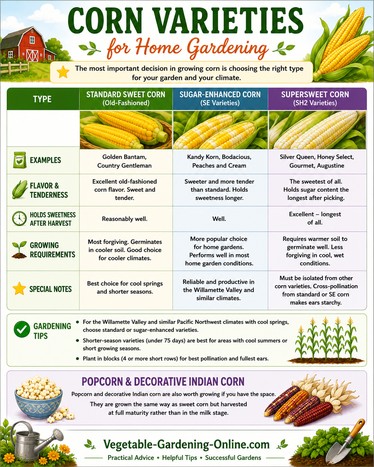
A very important decision in growing corn is choosing the right type for your garden and your climate. Sweet corn varieties fall into three main groups — standard, sugar-enhanced, and supersweet — and they differ significantly in flavor, tenderness, and how quickly the sugars convert to starch after harvest.
Standard sweet corn varieties like Golden Bantam and Country Gentleman have been grown in home gardens for generations. They have excellent old-fashioned corn flavor and hold their sweetness reasonably well after picking. These are the most forgiving varieties for growing corn in cooler climates since they germinate in cooler soil than the newer hybrid types.
Sugar-enhanced varieties — often labeled SE on seed packets — are sweeter and more tender than standard types and hold their sweetness longer after harvest. They are the most popular choice for home garden corn growing. Varieties like Kandy Korn, Bodacious, and Peaches and Cream fall into this group.
Supersweet varieties — labeled SH2 — are the sweetest of all and hold their sugar content the longest after picking. However growing corn from supersweet varieties requires warmer soil temperatures to germinate well and they can be less forgiving in cool, wet conditions. Isolation from other corn varieties is also important with supersweet types — cross-pollination from standard or SE corn turns supersweet corn starchy.
For growing corn in the Willamette Valley and similar Pacific Northwest climates with cool springs, standard or sugar-enhanced varieties reliably outperform supersweet types. Shorter-season varieties (under 75 days) are the best choice for growing corn in areas with cool summers or short growing seasons.
Popcorn and decorative Indian corn are also worth growing if you have the space. They are grown the same way as sweet corn but harvested at full maturity rather than in the milk stage.
When to Plant —
Getting the Timing Right for Growing Corn

Timing is very important for growing corn successfully. Corn is a warm-season crop that needs both warm air and warm soil to germinate and grow well. Planting too early in cold soil is one of the most common mistakes in growing corn — the seeds rot rather than germinate, and any plants that do emerge will be set back by cold temperatures.
The right time for growing corn outdoors is after your last spring frost date, when soil temperature at planting depth has reached at least 55 degrees Fahrenheit. Sweet corn germinates best when soil is between 60 and 95 degrees. Standard varieties germinate at lower soil temperatures than supersweet types, which really need 65 degrees or above for reliable germination.
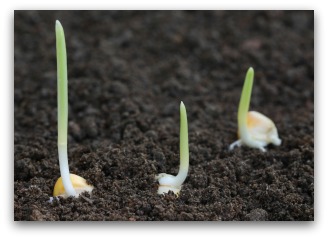
Do not start corn indoors. Corn develops a deep taproot very quickly and does not transplant well. Growing corn from direct sowing in warm soil gives you better results every time than trying to transplant seedlings.
In most areas growing corn planting dates fall between late April and early June depending on your zone. In the Willamette Valley, where I live, early to mid-May is the typical window for growing corn reliably — after the soil has had time to warm following the wet spring season.
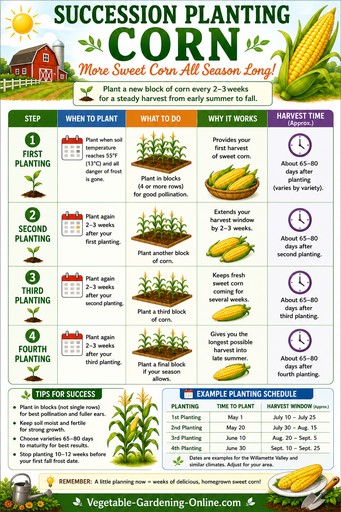
Succession planting is one of the most useful strategies for growing corn at home. Rather than planting one large block all at once, plant a small block every two weeks from your frost-free date through early summer. This staggers the harvest so you have fresh sweet corn over several weeks rather than all at once.
How to Plant Corn — Site, Soil, and Spacing
Growing corn requires full sun — at least eight hours of direct sunlight per day. Corn is a heavy feeder and does best in rich, well-drained soil with plenty of organic matter worked in before planting. Adding compost to the planting area before growing corn each season keeps the soil fertile and loose.
The most important rule in growing corn is to plant in blocks, not rows. Corn is wind-pollinated — the tassels at the top of each plant release pollen that must fall onto the silks emerging from each developing ear. A single long row of corn pollinates very poorly because wind carries the pollen sideways rather than down the row. Growing corn in a minimum of three to four short rows side by side — or a square block — ensures that every silk receives adequate pollen.
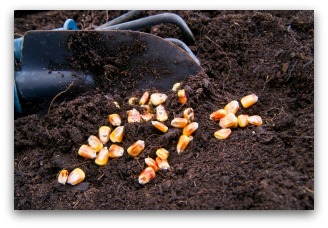
Plant corn seeds one inch deep and six to twelve inches apart within the row. Space rows thirty inches apart for standard varieties, slightly less for mini or compact varieties. Thin to one plant every twelve inches once seedlings are four to six inches tall if you planted more densely.
For growing corn in raised beds, the same block planting principle applies. A four-foot by eight-foot raised bed can support sixteen to twenty corn plants — enough for a modest harvest. Soil in raised beds warms faster in spring, which is an advantage for getting an early start on growing corn.
Growing Corn Through the Season —
Care and Feeding
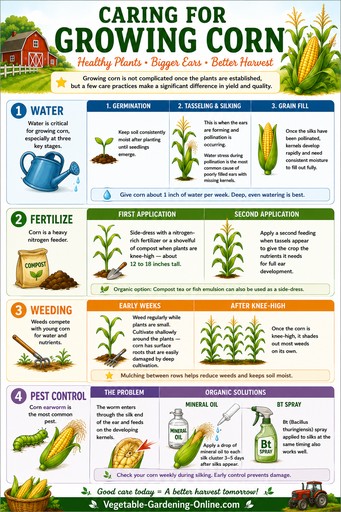
Growing corn is not complicated once the plants are established, but a few care practices make a significant difference in yield and quality.
Water is critical for growing corn, especially at three key stages.
- The first is germination — keep the soil consistently moist after planting until seedlings emerge.
- The second is tasseling and silking — this is when the ears are forming and pollination is occurring. Water stress during pollination is the most common cause of poorly filled ears with missing kernels in growing corn.
- The third is grain fill — once the silks have been pollinated, the kernels develop rapidly and need consistent moisture to fill out fully.
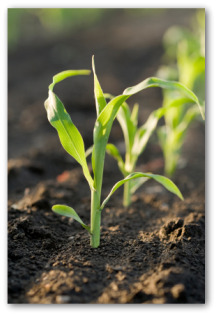
Fertilizing matters more for growing corn than for most other vegetables because corn is such a heavy nitrogen feeder. Side-dress plants with a nitrogen-rich fertilizer or a shovelful of compost when they are knee-high — roughly twelve to eighteen inches tall. A second application when the tassels appear gives the crop the nutrients it needs for full ear development.
Weeding is important in the early weeks of growing corn since young plants compete poorly with weeds. Cultivate shallowly around the plants — corn has surface roots that are easily damaged by deep cultivation. Once the corn is knee-high it shades out most weeds on its own.
Corn earworm is the most common pest in growing corn. The worm enters through the silk end of the ear and feeds on the developing kernels. Applying a drop of mineral oil to each silk cluster three to five days after silks appear is an effective organic control. Bt (Bacillus thuringiensis) spray applied to the silks at the same timing also works well.
Pollination —
The Key to Full Ears When Growing Corn
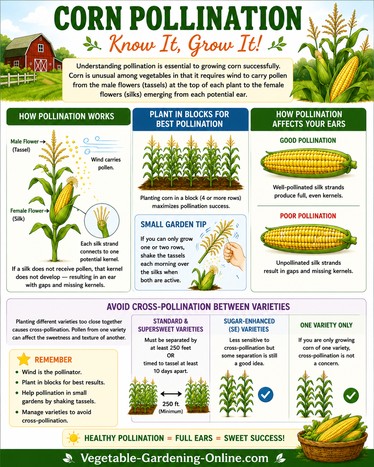
Understanding pollination is especially helpful to growing corn successfully. Corn is unusual among vegetables in that it requires wind to carry pollen from the male flowers (tassels) at the top of each plant to the female flowers (silks) emerging from each potential ear. Each individual silk strand connects to one potential kernel inside the developing ear. If a silk does not receive pollen, that kernel does not develop — resulting in an ear with gaps and missing kernels.
Growing corn in a block rather than a single row is super important, as it maximizes pollination success by ensuring pollen falls from tassels directly onto the silks below and on neighboring plants. If you are growing corn in a particularly small garden and can only manage one or two rows, help pollination along by shaking the tassels each morning over the silks when both are active.

Planting different varieties too close together causes cross-pollination when growing corn. Standard and supersweet varieties must be separated by at least 250 feet or timed to tassel at least ten days apart to prevent starchy cross-pollination. Sugar-enhanced varieties are less sensitive to this. If you are only growing corn of one variety, cross-pollination is not a concern.
Harvesting Sweet Corn — Knowing When It Is Ready
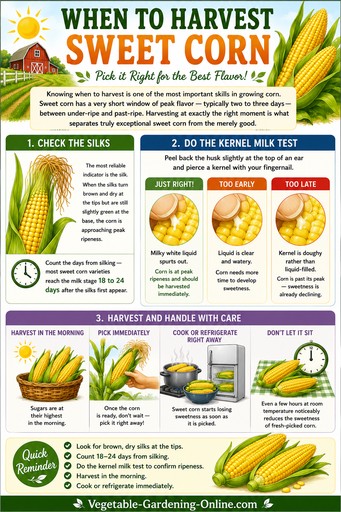
Knowing when to harvest is one of the most important skills in growing corn. Sweet corn has a very short window of peak flavor — typically two to three days — between under-ripe and past-ripe. Harvesting at exactly the right moment is what separates truly exceptional sweet corn from the merely good.
The most reliable indicator when growing corn is the silk. When the silks turn brown and dry at the tips but are still slightly green at the base, the corn is approaching peak ripeness. Count the days from silking — most sweet corn varieties reach the milk stage 18 to 24 days after the silks first appear.

To confirm ripeness when growing corn, peel back the husk slightly at the top of an ear and pierce a kernel with your fingernail. If a milky white liquid spurts out, the corn is at peak ripeness and should be harvested immediately. If the liquid is watery, it is too early. If the kernel is doughy rather than liquid-filled, you have waited too long.
Harvest in the morning when the sugars are at their highest. Cook or refrigerate immediately after picking. Even a few hours at room temperature noticeably reduces the sweetness of fresh-picked sweet corn.
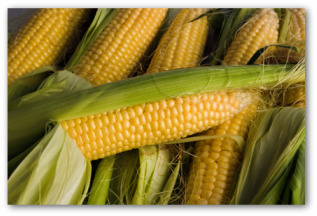
Growing Organic Sweet Corn
 Growing rows of sweet corn in an organic garden. Remember to block plant to aid pollination, rather than planting a single row.
Sweet corn can be grown by organic vegetable gardening.
Either purchase or use your own organic compost or fertilizer to enrich the soil when growing corn in your vegetable garden.
If you select a variety of corn seeds from your local garden center that is ideal for your climate and location, you will not likely have any reason to need to use pesticides or insecticides when growing corn.
More Vegetable Growing Guides

Growing corn pairs well with several other crops in the vegetable garden. The traditional Three Sisters planting — growing corn, beans, and squash together — is one of the oldest companion planting practices in North American gardening. The corn provides a structure for the beans to climb, the beans fix nitrogen that feeds the corn, and the squash shades the ground to retain moisture and suppress weeds.
- Growing Beans — pole beans, bush beans, and runner beans for the home vegetable garden
- Growing Squash — summer and winter squash varieties, planting, and care
- Companion Planting — which vegetables grow best together, including the Three Sisters planting
- Vegetable Garden Planting Times — complete planting times guide for all major vegetable crops
- Freezing Corn — how to freeze sweet corn at peak flavor for year-round enjoyment
- Growing Vegetables — complete hub for growing all types of vegetables at home
University of Minnesota Extension —
Growing Sweet Corn in the Home Garden
 If you have space for a large sweet corn patch, freshly picked corn, blanched, cooled, and frozen, makes delicious eating during the winter months!
- Growing Vegetables — complete hub for growing all vegetables at home
For additional research-based information on growing corn varieties, soil preparation, pest management, and harvesting — including a detailed variety comparison chart for sweet corn types — the University of Minnesota Extension at extension.umn.edu has one of the most comprehensive home garden corn growing guides available.
- University of Minnesota Extension — Growing Sweet Corn — research-based guide covering varieties, soil preparation, planting, pest management, and harvesting sweet corn in the home garden

Recent Articles


-
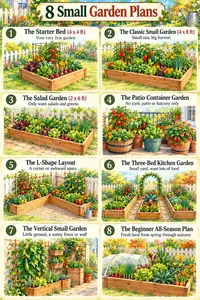
Small Vegetable Garden Plans: 8 Layouts That Maximise Space
Oct 08, 26 10:41 AM
 Small vegetable garden plans are some of the most searched and most valuable resources in home food growing.
 -
USDA Zone Finder - Find Your Vegetable Planting Dates | Vegetable-Gardening-Online.com
Oct 07, 26 03:53 PM
 Find your USDA hardiness zone, last spring frost date, and first fall frost date by state and region. Free interactive zone finder from Vegetable-Gardening-Online.com.
 -
Interactive Vegetable Garden Planner | Vegetable Gardening Online
Oct 07, 26 02:29 PM
Design a vegetable garden with correctly scaled plant spacing, companion flowers, drag-and-drop placement, and a printable plan. -
Free Printable Garden Stationery: Gardening Letter Paper & Note Cards
Oct 07, 26 12:48 PM
Free printable garden stationery: watercolor letter paper, lined and unlined, plus folded note cards with garden, fall, and Christmas scenes. Print at home. -
Free Preschool Vegetable Garden Cut and Paste Activities
Oct 07, 26 12:43 PM
 Free preschool vegetable garden cut and paste activities for ages 3-4. Build your own backyard, container, or seed packet garden scene, and sticker sheets.
 -
Planning a Vegetable Garden: Layouts, Raised Beds, Containers & More
Oct 06, 26 07:44 PM
 Planning a vegetable garden? Start here: layouts, raised beds, containers, square foot gardening, free planning tools, and tips to avoid beginner mistakes.
 -
How to Start a Vegetable Garden: 10 Easy Steps for Beginners
Oct 06, 26 04:38 PM
 How to start a vegetable garden in 10 easy steps: pick a sunny spot, choose raised beds or containers, prepare the soil, and grow easy vegetables.