Canning Tomato Juice:
A Tested Recipe from Your Garden
Canning tomato juice is a great way to use a big tomato harvest. Home-canned juice makes a delicious, healthy drink and a ready base for soups and stews all winter. This page follows the tested USDA method, with the added acid and processing times that keep it safe.
 ★ Save
Mother's Pantry Shelves
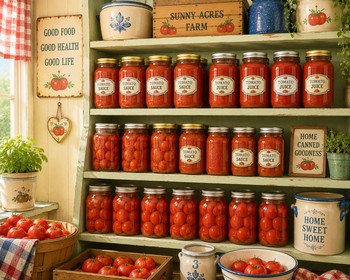
My mother always canned tomato juice in 2-quart jars at the end of summer. I can still see our pantry shelves stocked with an abundance of home-canned green beans, whole tomatoes, tomato juice, dill pickles, applesauce, pears, peaches, cherries, and many different kinds of jams, jellies, pickled crab apples, pickled figs, pickled beets, and so many other delicious delicacies that our family enjoyed all winter long.
Charlotte
A note on jar size: today's tested processing times for tomato juice are for pint and quart jars only. There is no tested time for half-gallon (2-quart) jars, so use quarts.
| Canning tomato juice at a glance | |
|---|---|
| Tomatoes | About 3 1/4 pounds per quart; 23 pounds for a canner load of 7 quarts |
| Acid (required) | Per quart: 2 tablespoons bottled lemon juice or 1/2 teaspoon citric acid. Per pint: half as much. |
| Salt (optional) | Up to 1 teaspoon per quart |
| Headspace | 1/2 inch |
| Boiling water canner | Pints 35 minutes, quarts 40 minutes (0 to 1,000 feet; longer at higher altitudes) |
| Pressure canner | Pints or quarts 15 minutes at 11 pounds (dial gauge) or 10 pounds (weighted gauge), 0 to 1,000 feet |
Always Add the Acid
Tomatoes are close to the line between high-acid and low-acid foods, and some varieties are not acidic enough to can safely on their own. Bottled lemon juice or citric acid must go in every jar of tomato juice, even if you add nothing else. Use bottled lemon juice, not fresh, because its acid level is always the same.
Follow the tested recipe exactly. Adding extra vegetables, cutting the processing time, or skipping the acid can allow botulism to grow.
What You Need for Canning Tomato Juice
 ★ Save
- Tomatoes: firm, ripe, disease-free tomatoes. Don't use tomatoes from dead or frost-killed vines, or overripe, bruised, or moldy ones.
- Bottled lemon juice or citric acid: required in every jar.
- Equipment: a boiling water canner or pressure canner, canning jars with new lids and bands, a large pot, and a food mill or fine sieve to remove seeds and peels.
New to canning? See our canning vegetables guide for the basics of jars, lids, and canners.
How to Can Tomato Juice, Step by Step
 ★ Save
- Wash and cut. Wash the tomatoes, remove the cores and blossom ends, and cut them into quarters.
- Heat quickly. Put about a pound of quartered tomatoes into a large pot and bring them right to a boil, crushing them as they heat. Keep adding and crushing more quartered tomatoes, keeping the pot boiling. Heating them fast keeps the juice from separating in the jar.
- Simmer. Once all the tomatoes are in, simmer for 5 minutes.
- Juice. Press the hot tomatoes through a food mill or fine sieve to remove the seeds and peels.
- Add the acid. Put 2 tablespoons of bottled lemon juice (or 1/2 teaspoon citric acid) in each hot quart jar, or 1 tablespoon (or 1/4 teaspoon citric acid) in each pint. Add up to 1 teaspoon of salt per quart if you like.
- Reheat and fill. Bring the juice back to a boil, and fill the hot jars, leaving 1/2 inch of headspace.
- Seal. Wipe the jar rims clean, and put on the lids and bands.
- Process. Process in a boiling water canner or a pressure canner, using the times below.
- Cool and check. Let the jars cool for 12 to 24 hours, then check that every lid has sealed. Refrigerate any that didn't, and use them within a few days.
Processing Times for Tomato Juice
Boiling water canner (time starts when the water returns to a full boil):
| Altitude | Pints | Quarts |
|---|---|---|
| 0 to 1,000 feet | 35 minutes | 40 minutes |
| 1,001 to 3,000 feet | 40 minutes | 45 minutes |
| 3,001 to 6,000 feet | 45 minutes | 50 minutes |
| Above 6,000 feet | 50 minutes | 55 minutes |
Pressure canner: process pints or quarts for 15 minutes at 11 pounds of pressure in a dial-gauge canner, or 10 pounds in a weighted-gauge canner, at 0 to 1,000 feet. At higher altitudes, the pressure goes up; follow your canner's instructions or the tested tables from your local Extension office.
Not sure of your altitude? Your county Extension office can tell you.
Tomato and Vegetable Juice Blend
 ★ Save
This tested blend is like a homemade vegetable juice cocktail. It makes about 7 quarts.
- 22 pounds tomatoes
- No more than 3 cups total of finely chopped celery, onions, carrots, and peppers, in any combination (for example, 3/4 cup each of carrots, celery, and green pepper, and 1/2 cup onion)
- Bottled lemon juice or citric acid
- Salt, if desired
- Make the tomato juice base. Crush and heat the tomatoes the same way as for plain tomato juice.
- Add the vegetables. Stir in the chopped vegetables, and simmer for 20 minutes.
- Juice. Press the hot mixture through a food mill or sieve.
- Acid, fill, and process exactly as for plain tomato juice: the same acid, 1/2 inch of headspace, and the same processing times.
Don't Add More Vegetables
The 3-cup limit is what makes this recipe safe to can in a boiling water bath. More low-acid vegetables, or other ingredients like parsley or garlic, make it unsafe.
Seasoning Your Tomato Juice
 ★ Save
Keep the canned juice plain, and season it when you open the jar. That way the flavor stays fresh, and the recipe stays safe.
- Herb tomato juice: stir in fresh chopped basil, dill, or parsley when you serve it.
- Spicy cocktail juice: add hot pepper sauce, Worcestershire sauce, black pepper, celery salt, and a squeeze of lemon to a chilled glass. It also makes a good base for Bloody Marys.
- A pinch of sugar softens the acid if you like it mild.
More Tomato Preserving Guides
This page is part of our Preserving Garden Vegetables hub. Label your jars with our free printable canning jar labels.
For tested recipes, processing times, and food safety information, see Penn State Extension's Let's Preserve: Tomatoes.
My short garden email, Get the Dirt, comes Saturday mornings.
Sign Up for My Free Newsletter