- Home
- Organic Vegetable Garden
- Landrace Gardening
How to Start Landrace Gardening
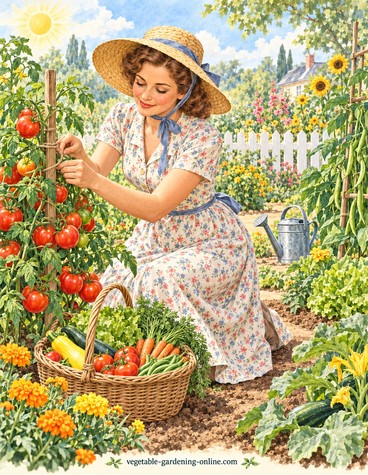 Gardening with the Landrace method.
Learning how to start landrace gardening means asking a different question: what if the plant adapted to your garden, instead of you constantly working to accommodate the plant?
Most of us garden the same way every year. We buy seed for a named variety, plant it, and hope the weather cooperates.
Landrace gardening is a method built around genetic diversity and cross-pollination. Instead of growing one single variety of tomato or squash, you grow several varieties together, let them cross-pollinate naturally, and save seed only from the plants that thrived with the least help from you.
Over a few seasons, the resulting seed becomes genuinely adapted to your own soil, climate, and growing conditions.
The method was popularized by Joseph Lofthouse, a gardener in a harsh, high-altitude, short-season climate in Utah, who wrote about it in his book Landrace Gardening: Food Security Through Biodiversity and Promiscuous Pollination.
Just getting started with a garden of your own? See our guide to homestead gardening for beginners for how a raised bed fits into growing more of your own food over time.
How Landrace Gardening Works
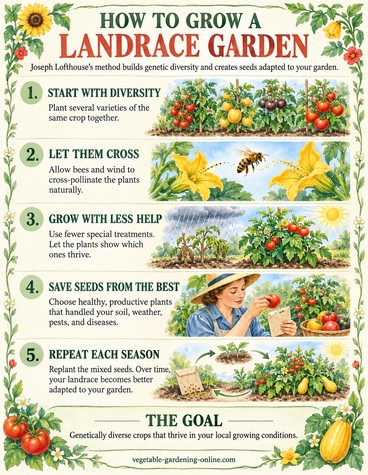
The core idea behind how to start landrace gardening is simple, even though it takes patience to see through.
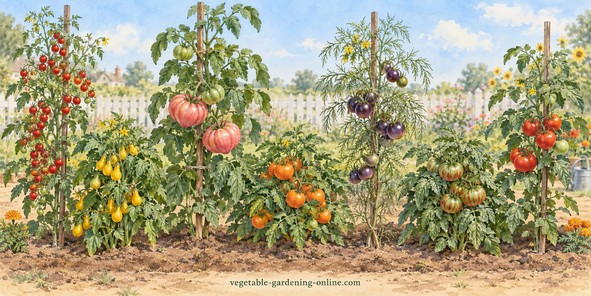
Plant several different varieties of the same crop close together, rather than just one.
This gives the plants a chance to cross-pollinate naturally, mixing their genetics rather than keeping each variety pure and separate.
Give the plants real growing conditions, not pampered ones.
Water and weed enough to get a harvest, but resist the urge to fix every problem for them.
The plants that struggle and fail tell you something useful.
The plants that thrive despite the conditions are the ones worth keeping.
Save seed only from your best performers, the plants that produced well with the least intervention from you.
Replant that seed the following year, and repeat the process.
Each generation, the seed becomes a little more suited to your specific garden.
The appeal of landrace gardening is really about reducing effort over time, not increasing it.
Why Try It
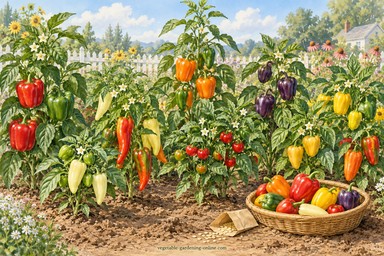
A landrace population is far more genetically diverse than a single named variety, so if one plant struggles with a drought, a pest, or a wet spring, others in the same row often do not.
That diversity is a form of insurance a single uniform variety cannot offer.
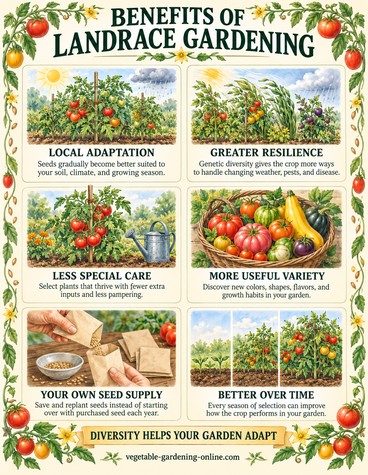
Over several seasons, many gardeners who learn how to start landrace gardening report needing less water, less fertilizer, and less pest management, simply because the surviving seed has already proven it can handle local conditions without much help.
This will not happen in a single season. It is the result of selecting for a few years running.
Landrace gardening also produces genuinely unique results.
Since the plants are crossing and adapting freely, your tomatoes or beans will eventually become something a little different from anyone else's, shaped entirely by your own garden.
A Real Example: My Niece's Experience
Landrace gardening is not just theory. My niece has been following Joseph Lofthouse's approach for about a year and a half, and her results speak for themselves. She recently told me:
"This year we were able to grow 50+ tomato plants and cabbages with no water, no fertilizer, and no weeding. I mulched them once when I put the young seedlings in. It's been fantastic and we got so many tomatoes. Cabbages are still growing but looking good. I'm now working on adapting all of our seeds to thrive in our area with little to no 'help' on my part. Gardening is quite fun when the plants aren't constantly trying to die, haha!"
That kind of result does not happen the first season.
It is the payoff of a year and a half of selecting for the plants that could genuinely handle her garden's conditions on their own.
Her experience is exactly the promise of learning how to start landrace gardening: less work for you, over time, as the plants themselves take on more of the burden of surviving.
htmlGood Crops to Start With
| Crop | Why It Works Well |
|---|---|
| Squash | Cross-pollinates easily; large, easy-to-save seeds |
| Beans | Large seeds, simple to collect and store |
| Corn | Cross-pollinates readily between varieties |
| Tomatoes | Slower to cross naturally, but very rewarding once established |
| Cabbage family | Cross-pollinates well within the same growing season |
How to Start Landrace Gardening
Here is exactly how to start landrace gardening in your own garden.
Start small, with one or two crops you actually enjoy eating, rather than trying to convert your whole garden at once.
Choose a crop you do not mind experimenting with for a few years before seeing real results.
Buy or trade several different varieties of that crop, rather than a single packet of one named variety.
Plant them together in the same bed so they have the chance to cross-pollinate. At harvest, save seed from whichever plants did best without extra help from you, and set that seed aside for next year.
Be patient. This is a multi-year project, not a single-season technique. The real payoff comes in year three or four, once your saved seed has had several chances to prove itself.
Related Reading
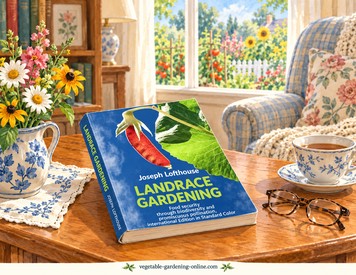 Read more about landrace gardening in the book by Joseph Lofthouse.
For a deeper, book-length treatment of this method, Joseph Lofthouse's Landrace Gardening: Food Security Through Biodiversity and Promiscuous Pollination covers breeding tomatoes, corn, beans, squash, and grains in detail, along with guidance on how many varieties to start with and how to manage cross-pollination.
Related guides: Organic Vegetable Garden | No-Dig Vegetable Gardening | Companion Planting of Vegetables

Recent Articles


-
How to Grow Cabbage
Sep 15, 26 12:33 PM
 How to Grow Cabbage: The Complete Guide from Seed to Harvest. This complete guide covers everything you need to know about how to grow cabbage.
 -
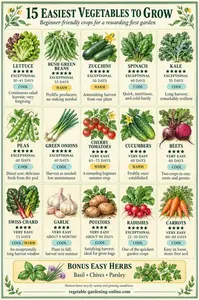
Easiest Vegetables to Grow: 15 Foolproof Crops for Beginners
Sep 15, 26 09:24 AM
 Easiest vegetables to grow for beginners - with advice on what makes each one easy, how to get started, and which vegetables are harder than they look.
 -
How to Grow Green Beans
Sep 14, 26 07:53 PM
 How to Grow Green Beans: The Complete Guide to Bush and Pole Beans. Green beans are one of the most forgiving crops a beginner can choose.
 -
Seasonal Vegetable Garden
Sep 14, 26 05:38 PM
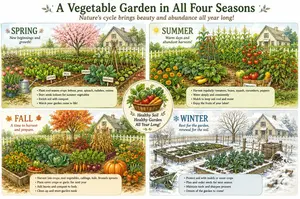
 Seasonal Vegetable Garden — Growing Food Through Every Season
 -
Overwintering Vegetables: Fall-Planted Crops for Early Spring Harvest
Sep 14, 26 05:35 PM
 Learn about overwintering vegetables like garlic, fava beans, and onions, planted in fall to sit through winter and reward you with an early spring harvest.
 -
Free Vegetable Garden Journal— Printable Downloads for Home Gardeners
Sep 14, 26 01:51 PM
 Download our free Vegetable Garden Journal — choose a full 16-page version or simpler 7-page journal. Track planting, harvest, & garden notes season by season.
 -
Free Vegetable Garden Cut and Paste Activities for Kids Ages 5-7
Sep 12, 26 09:13 PM
 Free printable vegetable garden cut and paste activities for kids ages 5-7. Build your own garden, match seeds to plants, and learn what grows where.