- Home
- Planning A Garden
- Square Foot Gardening
Square Foot Gardening: The Complete Beginner's Guide

Square foot gardening is the most space-efficient way to grow vegetables that most home gardeners have never tried - and once you do, you will wonder why you ever planted any other way. Square foot gardening divides your raised bed into a grid of individual one-foot squares, each planted with a different crop at the correct intensive spacing. The result is two to three times more food from the same space as traditional row gardening, with dramatically less weeding, watering, and work. By Vegetable-Gardening-Online.com | Updated May 2026 | 13 min read
Since Mel Bartholomew introduced the square foot gardening method in 1981, over 2.5 million copies of his book have sold - making it the best-selling vegetable gardening book in North America. Today square foot gardening is practiced by millions of home gardeners worldwide, from urban rooftop plots to suburban backyards. This guide covers everything you need to start your own square foot garden, including the complete spacing chart for all common vegetables.
What You Will Learn in This Square Foot Gardening Guide
- What square foot gardening is and why it works
- How square foot gardening compares to traditional row gardening
- Setting up your square foot garden - size, materials, and location
- Mel's Mix - the perfect square foot gardening soil
- Building the grid
- The square foot gardening spacing chart for every vegetable
- Planting your square foot garden
- Succession planting to keep harvests coming all season
- Watering, feeding, and maintaining a square foot garden
- Common square foot gardening mistakes and fixes
See also our hub page Planning a Vegetable Garden for more information.
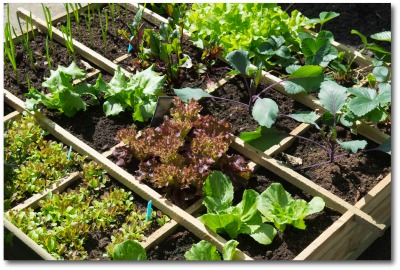
What Square Foot Gardening Is and Why It Works
Square foot gardening is a method developed by retired civil engineer Mel Bartholomew in the early 1980s after he noticed how wasteful traditional row gardening was. Row gardens dedicate enormous amounts of space to paths between rows, plant seeds far too thickly and then thin them out, and spread plants so far apart that weeds colonise the gaps. Most of the space, most of the water, and most of the effort goes to waste.
Square foot gardening replaces all of that with a simple, elegant system. You build a raised bed - typically 4 feet by 4 feet - fill it with a perfect soil mix, divide it into sixteen one-foot squares using a grid, and plant each square with the correct number of plants for that crop. No wasted space between rows. No thinning. No paths running through your bed. Just productive planting from edge to edge.
The square foot gardening method rests on ten core principles, of which the most important are:
- Plant densely - every square foot is planted, leaving no open soil for weeds
- No walking in the bed - the 4-foot width means you reach every square from the outside, so soil stays loose and uncompacted forever
- Perfect soil from day one - Mel's Mix creates ideal growing conditions in every square
- One crop per square - each square foot grows one type of vegetable at the correct intensive spacing
- Succession plant - as soon as one square is harvested, replant it with something new
Proven results: According to the Square Foot Gardening Foundation, the square foot gardening method uses 80% less space, 80% less water, and produces 100% fewer weeds than traditional row gardening - while yielding two to five times more food per square foot.
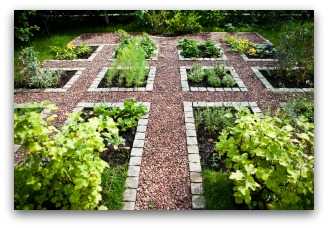
Square Foot Gardening vs Traditional Row Gardening
| Traditional Row Gardening | Square Foot Gardening |
|---|---|
| Wide paths between every row waste 80% of space | Every square foot is planted - no wasted space |
| Seeds sown thickly, then thinned - wasteful | Exact number of seeds or transplants per square - no waste |
| Weeds thrive in bare soil between plants | Dense planting shades out weeds - virtually no weeding |
| Soil compacts from walking between rows | Never walk in the bed - soil stays loose permanently |
| Hard to rotate crops systematically | Each square rotates independently - easy crop rotation |
| Requires large space to be productive | A 4x4 ft square foot garden can feed one to two people |
| High water use - watering large bare soil areas | Water only where plants grow - 80% less water |
Setting Up Your Square Foot Garden
Choosing the Right Size for Square Foot Gardening
The standard square foot garden is a 4-foot by 4-foot raised bed - exactly 16 square feet divided into 16 individual squares. The 4-foot width is the key dimension: it allows an adult to reach comfortably to the centre of the bed from either side without stepping inside. This keeps the soil loose and uncompacted, which is fundamental to how square foot gardening works.
You can make a square foot garden longer than 4 feet - 4x8, 4x12, or 4x16 ft beds are all common - but always keep the width at exactly 4 feet. If your square foot garden is accessible from only one side (against a wall or fence), keep the width to 2 feet.
| Square Foot Garden Size | Number of Squares | Best For |
|---|---|---|
| 4 x 4 ft | 16 squares | First-time square foot gardeners; very small spaces |
| 4 x 8 ft | 32 squares | The most popular size - feeds one to two people well |
| 4 x 12 ft | 48 squares | Families; serious food growers |
| 4 x 16 ft | 64 squares | Large households; selling surplus produce |
Location for Your Square Foot Garden
Like all vegetable gardens, square foot gardening requires sun first and everything else second. Choose the sunniest spot available - a minimum of 6 hours of direct sunlight daily, with 8 hours ideal for fruiting crops like tomatoes and peppers. Place taller crops at the north end of the bed so they cast shade away from shorter crops. Beyond sunlight, choose a location close to a water source - square foot gardening beds need regular watering.
Building the Square Foot Garden Box
The bed can be built from untreated cedar or redwood lumber (most popular), galvanised steel panels, composite lumber, or concrete blocks. Standard dimensions are 4 feet wide by any length, and at least 6 inches deep - though 12 inches is ideal for most crops, and 18-24 inches is perfect for deep-rooted crops and older gardeners who prefer not to bend.
Use our free planner: Our interactive vegetable garden planner uses the square foot gardening spacing system to show exactly how many plants fit in each square of your bed - before you buy a single seed or plant.
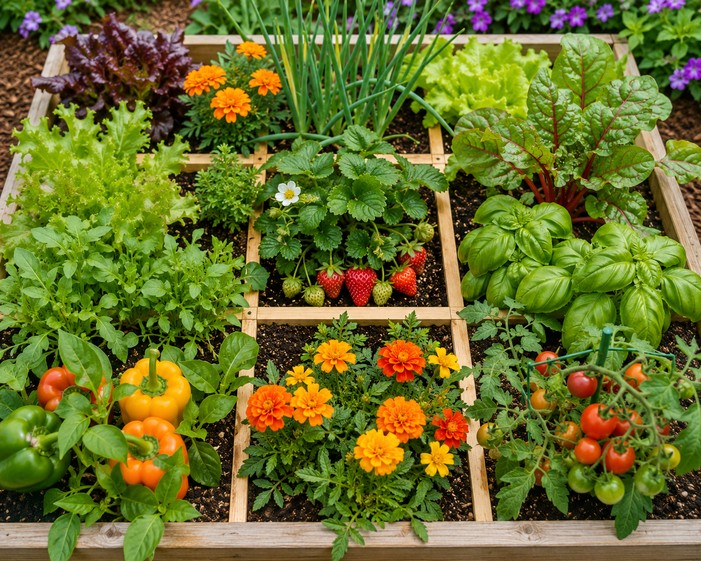
Mel's Mix - The Perfect Square Foot Gardening Soil
Mel Bartholomew's most important contribution to square foot gardening was not the grid - it was the soil recipe he developed to go in it. Mel's Mix is a blend of three equal parts that creates a perfectly balanced growing medium: light enough to never compact, rich enough to never need additional fertiliser, and moisture-retentive enough to reduce watering significantly.
Never fill a square foot garden bed with garden soil or straight topsoil. These compact heavily in a raised bed, drain poorly, and create exactly the conditions square foot gardening is designed to avoid.
Mel's Mix Recipe for Square Foot Gardening
| Ingredient | Proportion | Purpose in Square Foot Gardening |
|---|---|---|
| Blended compost | One third | Nutrition and moisture retention. Use a blend of several compost types for the best results - mushroom compost, garden compost, worm castings, and aged manure all contribute different nutrients. |
| Coarse vermiculite | One third | Aeration and moisture retention. Vermiculite holds water and nutrients in tiny pockets and releases them slowly to roots. Bartholomew specified coarse vermiculite specifically - the fine grade does not work as well in square foot gardening beds. |
| Peat moss or coir | One third | Structure and additional moisture retention. Coir (coconut fibre) is the more sustainable modern alternative to peat moss and works equally well in square foot gardening. |
For a standard 4x4 ft square foot garden at 12 inches deep, you need approximately 16 cubic feet of Mel's Mix. Mix the three ingredients thoroughly on a tarp before adding to the bed, moistening the peat or coir as you go since dry peat repels water initially.
Coarse vermiculite shortage: Coarse vermiculite has become expensive and harder to find in some areas. Many square foot gardening practitioners substitute perlite, which provides excellent drainage and aeration. The mix works well with perlite, though it retains slightly less moisture than the original Mel's Mix recipe.
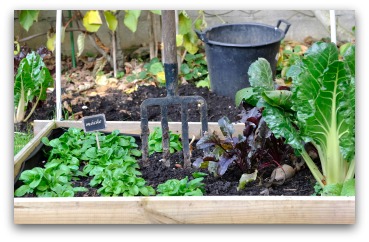
Building the Grid for Square Foot Gardening
The grid is what makes square foot gardening visually distinctive and practically effective. It divides the bed into clearly defined one-foot squares that make planting, spacing, and tracking what is growing where completely straightforward. Without the grid, square foot gardening quickly becomes a confused mess - the grid is not optional.
Materials for a Square Foot Garden Grid
- Wooden laths or thin timber strips - the most common choice; durable and attractive
- Heavy twine or rope - simple and inexpensive; stretch between small nails or hooks on the bed frame
- Vinyl mini-blinds cut to length - a popular upcycling option; weather-resistant and easy to cut
- PVC pipe - durable and lightweight; cut to length and rest across the bed frame
Whatever material you use, make sure the grid is permanent enough to stay in place through the season - you need it there every time you plant, not just the first time. The grid divides a 4x4 ft square foot garden into 16 squares, a 4x8 ft bed into 32 squares, and so on.
The Square Foot Gardening Spacing Chart
The heart of square foot gardening is the spacing system. Instead of following the wide row-spacing instructions on seed packets (which are designed for traditional row gardens with wasteful path space), square foot gardening uses intensive spacing based on the mature size of each plant. The number of plants per square foot varies from one large plant to sixteen tiny ones.
Use this square foot gardening chart as your planting guide:
| Plants per Square Foot | Vegetables | Spacing Within Square |
|---|---|---|
| 1 | Tomatoes, peppers, eggplant, broccoli, cabbage, cauliflower, kale, zucchini, cucumbers (with trellis), corn, sunflowers | One plant centred in the square |
| 2 | Not commonly used - most plants fit into 1 or 4 per square | Two plants spaced 6 inches apart |
| 4 | Lettuce (large), Swiss chard, basil, parsley, strawberries, marigolds, dwarf kale | Four plants in a 2x2 grid, 6 inches apart |
| 8 | Peas, bush beans | Eight plants in two rows of four, 4 inches apart |
| 9 | Spinach, beets, bush beans, turnips | Nine plants in a 3x3 grid, 4 inches apart |
| 16 | Carrots, radishes, onions, garlic | Sixteen plants in a 4x4 grid, 3 inches apart |
The memory shortcut: In square foot gardening, think of it this way - if the seed packet says space plants 3 inches apart, plant 16 per square. Six inches apart = 4 per square. Twelve inches apart = 1 per square. This simple rule covers the vast majority of square foot gardening crops.
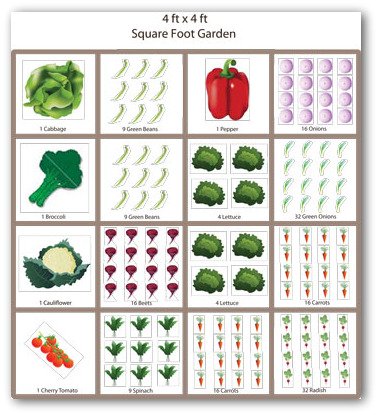
Sample Square Foot Garden Layout - 4x4 ft Bed
Here is an example of what a productive 4x4 ft square foot garden might look like in spring, using all 16 squares:
| Square | Crop | Plants per Square |
|---|---|---|
| 1 | Cherry tomato (with trellis at north edge) | 1 |
| 2 | Pepper | 1 |
| 3 | Basil | 4 |
| 4 | Marigolds (pest control) | 4 |
| 5 | Lettuce mix | 4 |
| 6 | Spinach | 9 |
| 7 | Carrots | 16 |
| 8 | Radishes | 16 |
| 9 | Green onions | 16 |
| 10 | Peas (with small trellis) | 8 |
| 11 | Bush beans | 9 |
| 12 | Beets | 9 |
| 13 | Kale | 1 |
| 14 | Broccoli | 1 |
| 15 | Cucumber (with trellis) | 1 |
| 16 | Parsley | 4 |
That is 16 different crops in 16 square feet - a level of diversity and productivity that would require a traditional row garden many times larger to replicate. Use our free interactive garden planner to design your own square foot garden layout and check companion planting before you plant anything.
Design Your Square Foot Garden Online
Our free interactive garden planner uses square foot gardening spacing to show exactly how many plants fit in each square - with companion planting checks built in.
Open the Free Garden Planner
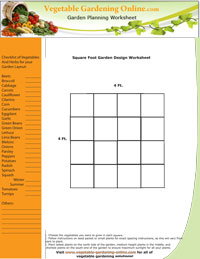
Download Free Square Foot Worksheets
Planting Your Square Foot Garden
One of the greatest pleasures of square foot gardening is how simple planting day becomes. Because Mel's Mix is perfectly loose and weed-free, there is no preparation beyond smoothing the surface of the relevant square with your hand. Then:
- Mark your squares - make sure your grid is in place before you start planting
- Make planting holes - use a finger, a pencil, or a dibber to make holes at the correct spacing for each square according to the square foot gardening chart above
- Plant seeds or transplants - sow 2-3 seeds per hole and thin to 1 after germination, or set transplants directly into the holes
- Water gently - water the entire square after planting; do not allow Mel's Mix to dry out completely in the first few days after sowing
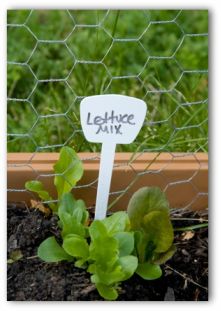
- Label each square - a simple plastic label or wooden stake prevents confusion as the season progresses
Tall plants at the north end: In square foot gardening, always place your tallest crops - tomatoes, trellised cucumbers, corn, sunflowers - along the northern edge of the bed. This prevents them from shading the shorter crops occupying the other 15 squares as the season progresses.
Succession Planting in Square Foot Gardening
Succession planting is what takes square foot gardening from a productive garden to an extraordinary one. The principle is simple: the moment a square foot is harvested, it gets replanted with something new. This is only possible in square foot gardening because each square is independent - one square finishes while the others continue producing.
A well-managed 4x4 ft square foot garden can produce three or four complete harvests from each square in a single growing season. In practice that means:
- Radishes in early spring (25 days) → replaced with beans for summer → replaced with spinach for autumn
- Lettuce in spring → replaced with tomato transplant for summer → replaced with garlic for overwintering
- Peas in cool spring → replaced with cucumbers when warm → replaced with kale for autumn
No other gardening method makes succession planting as easy and intuitive as square foot gardening. The grid makes it obvious which squares are available, and the square-by-square structure means you replant one square without disturbing any of the others.
Download our free worksheets for planning your square foot garden!
Download Free Garden Planning Worksheets, Garden Diary, Zone Chart, Or Planting Guide
Click Here for a Free Square-Foot Garden Plan

Watering, Feeding, and Maintaining a Square Foot Garden
Watering Your Square Foot Garden
Square foot gardening beds dry out faster than in-ground gardens because they are raised and exposed on all sides. In hot summer weather, daily watering is often necessary. The Mel's Mix soil blend is very moisture-retentive which helps, but the finger test is always the reliable guide: push your finger one inch into the soil surface - if it feels dry, water thoroughly.
Water slowly and deeply at the base of plants, not overhead. Many square foot gardening practitioners use a simple drip system or soaker hose on a timer, which makes consistent watering automatic and reduces the risk of inconsistent moisture causing problems like blossom end rot in tomatoes.
Feeding Your Square Foot Garden
Mel Bartholomew claimed that Mel's Mix never needs additional fertiliser - and for light crops in a freshly made bed, this is broadly true. However, for heavy-feeding crops like tomatoes, peppers, corn, and cucumbers, most square foot gardening practitioners find that a liquid vegetable feed applied every two weeks once flowering begins makes a noticeable difference to yields. After the first season, top up the bed with 1-2 inches of fresh compost each spring to restore fertility.
Weeding
This is where square foot gardening truly shines. The dense planting that fills every square foot means very little bare soil is ever exposed for weeds to colonise. Most square foot gardening practitioners find they spend less than five minutes per week on weeding - compared to hours in a conventional row garden of the same area.

Common Square Foot Gardening Mistakes and How to Fix Them
- Using the wrong soil. Filling a square foot garden box with topsoil or garden soil is the most common and most damaging mistake. It compacts, drains poorly, and defeats the entire purpose of square foot gardening. Always use Mel's Mix or an equivalent loose, rich potting mix.
- Making the bed wider than 4 feet. The moment you need to step inside a square foot garden to reach plants, you compact the soil that makes the system work. Keep beds at 4 feet wide maximum.
- Skipping the grid. Without the grid, square foot gardening devolves into guesswork. The grid is what makes exact spacing, easy succession planting, and clear crop rotation possible. Make one and keep it in place all season.
- Planting too many large crops. In a 4x4 ft square foot garden, one tomato plant occupies 1 out of 16 squares - perfectly reasonable. But plant 6 tomatoes and you have used up more than a third of your space on one crop. Mix large and small crops for the best square foot gardening experience.
- Not succession planting. Empty squares are wasted opportunity. The whole point of square foot gardening is that when one crop finishes, the next one goes in immediately. A square left bare for even two weeks is two weeks of potential food production lost.
- Forgetting the annual compost top-up. After the first season, add 1-2 inches of compost to the surface each spring before planting. This keeps Mel's Mix rich and loose year after year.
- Making it too complicated at first. The best square foot gardening advice for beginners is to start with a single 4x4 ft bed and master it before expanding. One bed done well is far more productive and satisfying than three beds done poorly.
Frequently Asked Questions About Square Foot Gardening
How many people can a square foot garden feed?
A single well-managed 4x8 ft square foot garden (32 squares) with succession planting can supply a significant portion of salads, herbs, and vegetables for one to two people through the growing season. For a family of four, two to three 4x8 ft square foot gardening beds growing a mix of cool and warm season crops will provide regular harvests.
Does square foot gardening work in containers?
Yes - the square foot gardening principle of intensive spacing and grid-based planting can be applied to any container large enough to accommodate a grid. A 24-inch square planter divided into four one-foot squares works very well for salad crops, herbs, and radishes on a patio or balcony.
Can I use square foot gardening without building a raised bed?
Technically yes - you can mark a grid directly on prepared in-ground soil. But the square foot gardening method works best in a raised bed filled with Mel's Mix because that soil never compacts. In-ground soil, even well-prepared, gradually compacts over time as it gets watered.
How deep should a square foot garden bed be?
The minimum depth for square foot gardening is 6 inches, which suits shallow-rooted crops like lettuce and herbs. Twelve inches is the standard recommended depth and suits most vegetables. For deep-rooted crops like carrots, parsnips, and tomatoes, or for gardeners who prefer not to bend, 18-24 inches is ideal.
Is the spacing in square foot gardening really different from conventional spacing?
Yes - significantly so. The spacing on most seed packets is designed for traditional row gardens where wide paths between rows are counted in the spacing. Square foot gardening uses true plant-to-plant spacing based on the actual space each mature plant needs, without any buffer for walking paths. This is why square foot gardening fits so many more plants into the same space.
Does square foot gardening work for tomatoes?
Tomatoes are one plant per square foot in square foot gardening - they need the full 12 inches of spacing on all sides. Cherry tomatoes work especially well in square foot gardening, occupying one square and producing prolifically when trained up a trellis at the north end of the bed. Large slicing tomatoes can be grown using square foot gardening spacing but do better with a 2-foot spacing - meaning one plant per two adjacent squares.


Start Your Square Foot Garden Today
Square foot gardening is the simplest, most productive, and most beginner-friendly approach to growing vegetables that exists. You do not need gardening experience, large amounts of space, or expensive equipment. You need a 4x4 ft box, three bags of ingredients for Mel's Mix, a simple grid, and a handful of seeds. That is all it takes to start a square foot garden that will produce more food from 16 square feet than most traditional gardens produce from a plot four times the size.
Build one square foot garden this weekend. Plant it well. Watch it grow. Succession plant every square that finishes. By the end of the season you will understand exactly why square foot gardening has sold 2.5 million books and helped millions of gardeners around the world grow more food with less effort than they ever thought possible.
Plan Your Square Foot Garden Now
Use our free interactive planner to design your grid, choose your vegetables, and check companion planting - all before you build anything.
Free Interactive Garden Planner
Find Your Planting Zone
More Vegetable Gardening Guides
- How to Start a Vegetable Garden from Scratch
- Raised Bed Vegetable Gardening for Beginners
- No-Dig Vegetable Gardening: The Complete Guide
- Container Vegetable Gardening Guide
- Companion Planting Chart for Vegetables
- Vegetable Garden Layout Ideas
- Free Interactive Vegetable Garden Planner
- Free Planting Worksheets and Zone Charts