- Home
- Growing Fruit and Berries
- Blackberries
All About How to Grow Blackberries

How to grow blackberries at home in easy steps.
Learn how to plant, care for, and harvest blackberry bushes in your home garden.
Design Your Own Vegetable Garden Layout Using our Free "Vegetable Garden Planner" Software!
Blackberries are very easy and trouble-free plant to grow in your garden.
We find that is is usually much more difficult to get rid of unwanted blackberries, than it is to get them to thrive in the garden!
Although most available gardening literature tends to focus more on vegetable gardening than providing information about the berry patch, we decided to remedy that!
Let's start with the basics of how to grow blackberries.
Download Free Garden Planning Worksheets, Garden Diary, Zone Chart, Or Planting Guide
One complication gardeners face with growing berries is that they are perennial plants.
You can always find a better tomato variety compatible to your location, but it is not as easy to change varieties of growing blackberries.
Growers find it is much more cost effective to prevent difficulties from the start rather than to treat them later.
Knowing how to grow blackberries well means understanding their growth habits and working with them. A little annual maintenance makes all the difference between a productive patch and an unmanageable thicket.
This page is part of our Growing Fruit and Berries hub, where you will find guides to strawberries, raspberries, blueberries, gooseberries, and all the best fruits for the home garden.
Growing Fruit and Berries — complete hub for growing strawberries, raspberries, blackberries, blueberries, and gooseberries at home
 Blackberries ripening on the vine.
Growing Blackberries
- Blackberry plants grow anywhere from 5 to 26 feet!
- Their root depth is more than a foot deep.
- It is typically 2 years until blackberries bear fruit.
- The bushes will produce for over a decade after reaching bearing age.
- Growing blackberries require some shade of at least 2 to 4 hours in hot climates.
- In the northern part of the country, the plants need full sun.
- The plants can be grown successfully in zones 5 to 8.
- The preferred soil pH is 5.0 to 6.0.
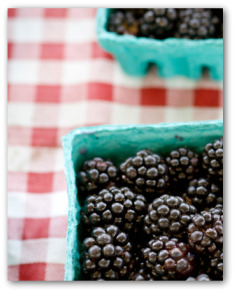 Freshly picked blackberries ready for whatever comes next; smoothie, pie, jam, jelly, etc.
How to Grow Blackberries
- Planting Blackberries: The best method of creating new plants is to transplant dormant suckers.
- Propagation can take place in the springtime, autumn, or winter where the winters are very mild.
- Plant 5-6 inches deep.
- Space upright plants, 3 feet apart.
- Spacing between trailing plants should be 5 to 8 feet.
Caring for Blackberries
- Make certain the plants get one inch of water every week either by watering or from rain.
- When the bushes begin producing fruit, give them 1 to 1 ½ inches of water per week.
- Apply compost or a slow-acting fertilizer in the spring as the leaves are beginning to appear.
- Spray plants with liquid seaweed extract several times during the growing season.
Excess Growth in the Blackberry Plant
Plants that produce too much vegetation may not harden off early enough in the fall.
This leaves them vulnerable to severe damage if winter comes early.
Additionally, these plants will form few fruit buds for the following year, which means less fruit production.
Excessive growth is usually caused by pruning or feeding the plants too much.
Cut back on nitrogen and pruning.
 Freshly harvested fruit and berries from the garden.
Blackberry Plant Pest
Blackberry plants are usually disease-free.
In the event that your plants are not thriving, there can be a pest involved.
Sudden wilting of the tips of blackberry canes is the first sign that raspberry cane borers have infected your plants.
Closer examination of the canes will show two rows of punctures about one inch apart at the tip of the cane.
The adult cane borer is a bluish black beetle with a red thorax, which lays eggs between the rows of small holes.
To destroy the larva, cut off the wilted tops below the lower row of tiny wound marks and burn them.
Common Disease of the Blackberry Plant
Blackberries are very hardy plants, and are not usually bothered by disease.
However, be on the safe side by starting out with disease-free plants.
If new canes show reddish-brown or purplish spots, suspect anthracnose.
As the canes grow, these spots enlarge, become round, turn gray in color, develop shrunken centers, and grow together.
 Blackberries go amazingly well with vanilla ice cream!
Small, irregular, yellow or purple spots also appear on the leaves.
On spotting the disease symptoms, apply fungicide such as copper dust every 7 to 10 days.
To prevent anthracnose, use a dormant oil spray in late winter before budding begins.
Harvesting Blackberries
Everyone's favorite part of how to grow blackberries is the harvest!
Pick the berries in the early morning just after their color has become dull.
Check plants every couple of days for ripe blackberries.

Recent Articles


-
Free Printable Return Address Labels: Garden and Christmas
Oct 11, 26 10:32 AM
Free printable return address labels with watercolor garden and Christmas designs. Type your address, pick a picture, and print on Avery 5160 label sheets. -
Free Printable Canning Jar Labels: Regular, Wide Mouth & Jam Jars
Oct 11, 26 10:29 AM
 Free printable canning jar labels for regular and wide mouth lids and jam jars: tomatoes, salsa, pickles, green beans, peaches, pears, and jam.
 -
Free Printable Gift Tags: Garden, Harvest, and Christmas
Oct 11, 26 10:24 AM
 Free printable gift tags and folded gift cards in watercolor garden designs: flowers, harvest, Thanksgiving, winter, and Christmas. Print at home on cardstock.
 -
Free Vegetable Garden Printables — Downloads for Every Gardener
Oct 11, 26 10:15 AM
 Browse our complete library of free vegetable garden printables, from planning worksheets and growing charts to kids' activities, all free to download & print.
 -
Free Printable Gift Stickers: Christmas and Garden Designs
Oct 11, 26 10:00 AM
Free printable round gift stickers with watercolor garden and Christmas pictures. Add a message or To and From, and print on 2-inch labels at home. -
Free Printable Garden Calendar 2027: 12 Watercolor Months (PDF)
Oct 10, 26 10:30 AM
 Free printable garden calendar for 2027: 12 watercolor garden scenes, a monthly garden task, and room to write. Print the whole year or one month at a time.
 -
Free Printable Garden Stationery: Gardening Letter Paper & Note Cards
Oct 10, 26 10:22 AM
 Free printable garden stationery: watercolor letter paper, lined and unlined, plus folded note cards with garden, fall, and Christmas scenes. Print at home.