- Home
- Free Garden Printables
- Free Vegetable Garden Checklist
Free Vegetable Garden Checklist
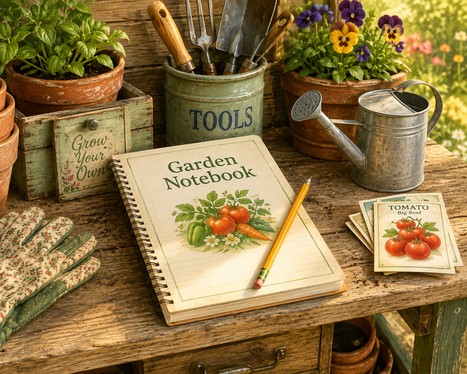
Every gardener I have ever known, myself included, does better work in the garden with a list in hand than trying to keep it all in their head.
This free vegetable garden checklist is organized by season, so you can see at a glance what needs doing right now, whether that is starting seeds indoors in late winter or putting the garden to bed in late fall.

I have been around vegetable gardens most of my life, and the tasks below are the same ones my own family has relied on for generations, just written down in one place instead of carried around in memory.
Print this free vegetable garden checklist and keep it wherever you will actually see it, whether that is tucked into a garden journal or taped inside a shed door.
Spring Checklist
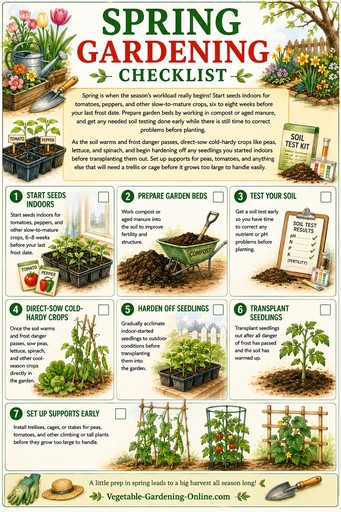
Spring is when the season's workload really begins.
Start seeds indoors for tomatoes, peppers, and other slow-to-mature crops, six to eight weeks before your last frost date.
Prepare garden beds by working in compost or aged manure, and get any needed soil testing done early while there is still time to correct problems before planting.
 Spring vegetable gardening checklist; lettuce is one of the earlier crops to plant.
As the soil warms and frost danger passes, direct-sow cold-hardy crops like peas, lettuce, and spinach.
Begin hardening off any seedlings you started indoors before transplanting them out.
Set up supports for peas, tomatoes, and anything else that will need a trellis or cage before it grows too large to handle easily.
Summer Checklist
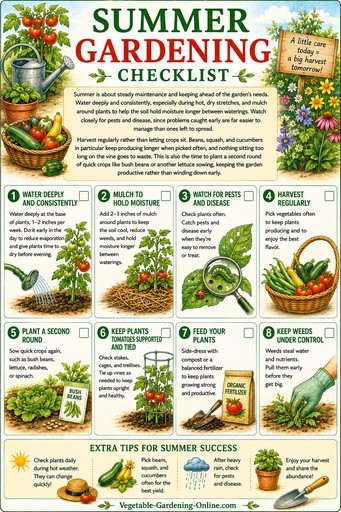
Summer is about steady maintenance and keeping ahead of the garden's needs.
Water deeply and consistently, especially during hot, dry stretches, and mulch around plants to help the soil hold moisture longer between waterings.
Watch closely for pests and disease, since problems caught early are far easier to manage than ones left to spread.

Harvest regularly rather than letting crops sit.
Beans, squash, and cucumbers in particular keep producing longer when picked often, and nothing sitting too long on the vine goes to waste.
This is also the time to plant a second round of quick crops like bush beans or another lettuce sowing, keeping the garden productive rather than winding down early.
Fall Checklist
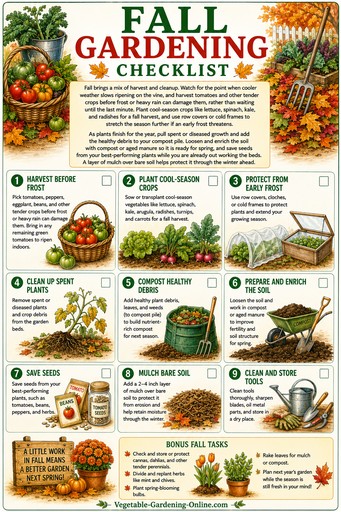
Fall brings a mix of harvest and cleanup.
Watch for the point when cooler weather slows ripening on the vine, and harvest tomatoes and other tender crops before frost or heavy rain can damage them, rather than waiting until the last minute.
Plant cool-season crops like lettuce, spinach, kale, and radishes for a fall harvest, and use row covers or cold frames to stretch the season further if an early frost threatens.
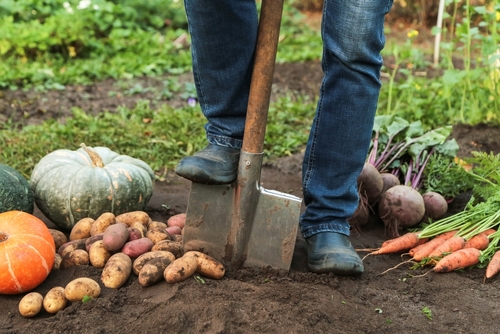 Autumn vegetable garden checklist; time to harvest!
As plants finish for the year, pull spent or diseased growth and add the healthy debris to your compost pile.
Loosen and enrich the soil with compost or aged manure so it is ready for spring, and save seeds from your best-performing plants while you are already out working the beds.
A layer of mulch over bare soil helps protect it through the winter ahead.
Winter Checklist
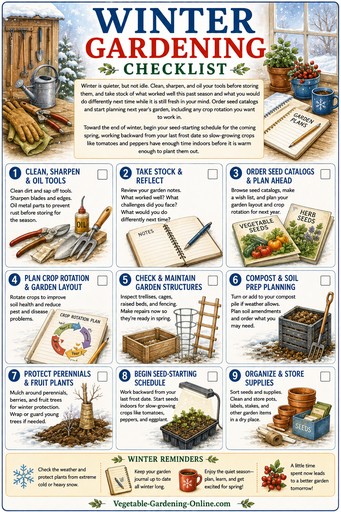
Winter is quieter, but not idle.
Clean, sharpen, and oil your tools before storing them, and take stock of what worked well this past season and what you would do differently next time while it is still fresh in your mind.
Order seed catalogs and start planning next year's garden, including any crop rotation you want to work in.
 Cold season vegetables can thrive throughout the winter months.
Toward the end of winter, begin your seed-starting schedule for the coming spring, working backward from your last frost date so slow-growing crops like tomatoes and peppers have enough time indoors before it is warm enough to plant them out.
Why a Free Vegetable Garden Checklist
Is Worth Keeping On Hand
A garden has a way of humbling even an experienced gardener who trusts memory alone.
There is always more happening at once than it seems, and a task easily gets pushed aside in a busy week only to be forgotten entirely by the next one.
Keeping a free vegetable garden checklist within reach all season is a simple habit that saves a surprising amount of frustration later, whether that means catching a planting window before it closes or getting frost protection up in time to save a harvest.
I would also encourage you to make this free vegetable garden checklist your own.
Cross off what does not apply to your garden, and add your own notes in the margins about what worked, what did not, and what you want to remember for next year.
A checklist like this one is meant to be a starting point, not a strict set of rules.
Quick Reference: Checklist by Season
| Season | Focus |
|---|---|
| Spring | Start seeds, prepare soil, direct-sow cold-hardy crops, set up supports |
| Summer | Water deeply, mulch, watch for pests, harvest often, succession plant |
| Fall | Harvest before frost, plant cool-season crops, clean up, enrich soil, save seeds |
| Winter | Clean tools, review the season, plan ahead, begin seed starting late in the season |
Related Reading
For more detail on any one season, see our guides to spring, summer, fall, and winter vegetable gardening.
If you are working through this checklist right now because your outdoor tomato season is wrapping up, our page on how to ripen green tomatoes indoors is worth a look before you pull those last plants.
Related guides: Seasonal Vegetable Garden | Fall Vegetable Garden | How to Ripen Green Tomatoes Indoors | Zone Finder

Recent Articles


-
How to Grow Cabbage
Sep 15, 26 12:33 PM
 How to Grow Cabbage: The Complete Guide from Seed to Harvest. This complete guide covers everything you need to know about how to grow cabbage.
 -
Easiest Vegetables to Grow: 15 Foolproof Crops for Beginners
Sep 15, 26 09:24 AM
 Easiest vegetables to grow for beginners - with advice on what makes each one easy, how to get started, and which vegetables are harder than they look.
 -
How to Grow Green Beans
Sep 14, 26 07:53 PM
 How to Grow Green Beans: The Complete Guide to Bush and Pole Beans. Green beans are one of the most forgiving crops a beginner can choose.
 -
Seasonal Vegetable Garden
Sep 14, 26 05:38 PM
 Seasonal Vegetable Garden — Growing Food Through Every Season
 -
Overwintering Vegetables: Fall-Planted Crops for Early Spring Harvest
Sep 14, 26 05:35 PM
 Learn about overwintering vegetables like garlic, fava beans, and onions, planted in fall to sit through winter and reward you with an early spring harvest.
 -
Free Vegetable Garden Journal— Printable Downloads for Home Gardeners
Sep 14, 26 01:51 PM
 Download our free Vegetable Garden Journal — choose a full 16-page version or simpler 7-page journal. Track planting, harvest, & garden notes season by season.
 -
Free Vegetable Garden Cut and Paste Activities for Kids Ages 5-7
Sep 12, 26 09:13 PM
 Free printable vegetable garden cut and paste activities for kids ages 5-7. Build your own garden, match seeds to plants, and learn what grows where.