- Home
- Organic Vegetable Garden
- Homestead Gardening
Homestead Gardening for Beginners
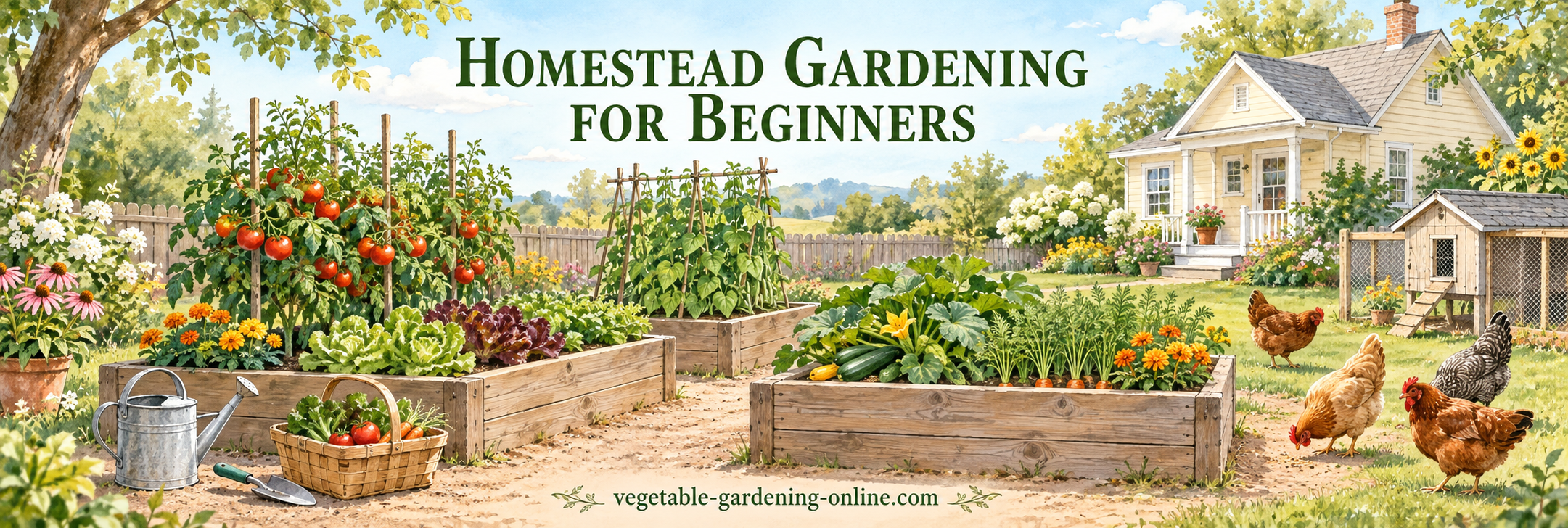 Image of a country vegetable garden, with a few chickens nearby.
Homestead gardening for beginners is really about a shift in mindset more than a change in acreage.
Homesteading sounds like it requires forty acres, a tractor, and a herd of animals.
It does not. At its core, homesteading is simply the habit of growing and raising more of what you eat yourself, and a vegetable garden is where nearly everyone starts.
You do not need to move to the country. You need a sunny spot, decent soil, and a willingness to start small and build from there.
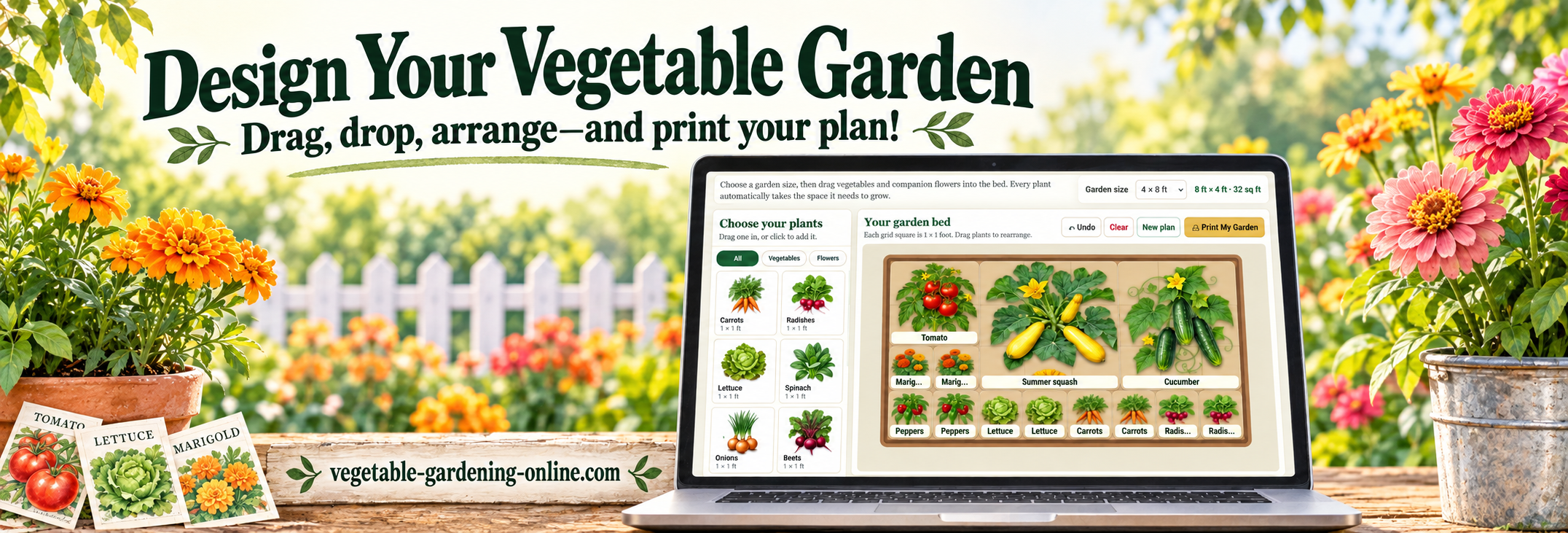
This page covers the basics: what to grow first, how to prepare the ground you have, and how to grow your homestead garden a little each year rather than trying to do everything at once.
Start with What You'll Actually Eat
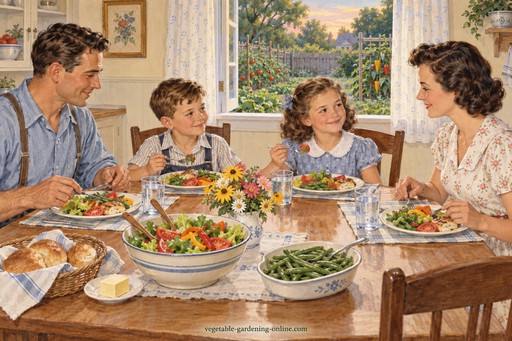 Grow vegetables that your family will enjoy eating.
The most common mistake in homestead gardening for beginners is growing too much, too soon, of things nobody in the family actually wants to eat.
Start with the vegetables your family already reaches for at the grocery store.
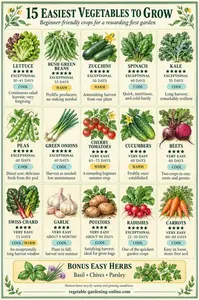
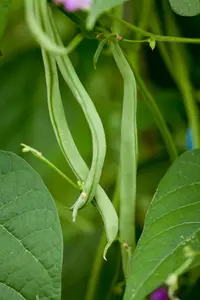
Tomatoes, lettuce, green beans, and peppers are a good, forgiving place to begin, since all four grow well in a wide range of soils and climates.
Add one or two new crops each year rather than trying an entire seed catalog the first season.
A homestead garden is meant to feed you, not overwhelm you.
A small, well-tended plot that actually gets used and eaten from is worth far more than a large one that gets away from you by midsummer.
Homestead Gardening for Beginners
Starts with the Soil
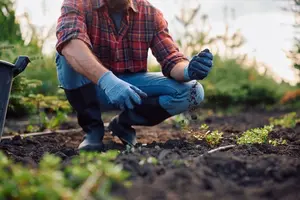
 Healthy soil is the foundation of a healthy garden.
Whatever ground you are starting with, the soil is where homestead gardening for beginners really begins.
Good soil forgives a lot of other mistakes.
Poor soil undermines even careful watering and perfect timing.
Raised beds are one of the fastest ways to get good growing soil, regardless of what your native ground is like.
Fill a raised bed with a mix of quality topsoil and compost, and you sidestep problems like heavy clay, poor drainage, or contaminated urban soil entirely.
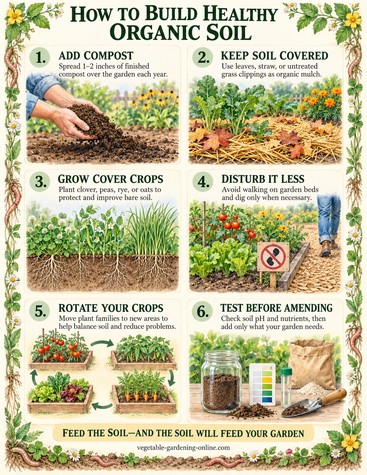
If you are working with in-ground beds instead, start feeding the soil with compost and aged manure right away, and keep at it every season. Homestead gardening for beginners is as much about building soil over years as it is about growing any single crop this season.
A Simple First-Year Homestead Garden Plan
| Space Available | Good Starting Point |
|---|---|
| A few containers | Tomatoes, peppers, herbs, lettuce |
| One raised bed (4x8 feet) | Tomatoes, beans, lettuce, a few herbs |
| A small backyard plot | Above, plus squash, cucumbers, and root vegetables |
| A quarter acre or more | Above, plus corn, a small orchard, or laying hens |
Growing Toward Self-Sufficiency,
One Season at a Time
 A pantry stocked with home grown and canned fruits and vegetables.
Real self-sufficiency is built in layers, not all at once. Most homesteaders start with a vegetable garden, then add preserving what they grow, then maybe a few laying hens, then fruit trees or berry bushes. Each layer builds on the last.
Learning to preserve your harvest through canning, freezing, or simple root cellar storage stretches a single season's garden into food for months, and is one of the most valuable skills to add early.
Saving your own seed each year is another good habit to build, since it saves money and, over time, gives you seed that is genuinely suited to your own garden.
There is no fixed timeline for any of this. Homestead gardening for beginners is meant to grow at whatever pace fits your life, your space, and your energy.
Landrace Gardening: A Natural Next Step
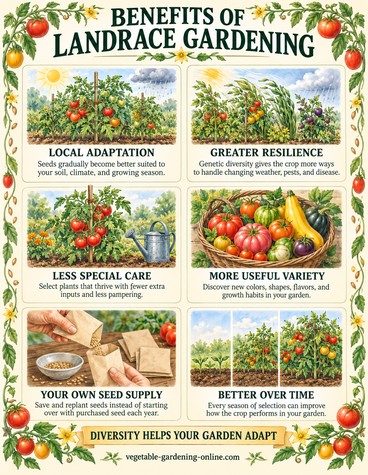 The six benefits of landrace gardening.
Once your homestead garden is established, landrace gardening is a natural direction to grow into.
Rather than buying new seed every year, you save seed from whatever performed best with the least help from you, and replant it.
Over a few seasons, your own saved seed becomes genuinely adapted to your particular soil and climate, needing less water, less fertilizer, and less coddling than anything you could buy off a shelf.
See our guide on how to start landrace gardening to learn the method.
Related Reading
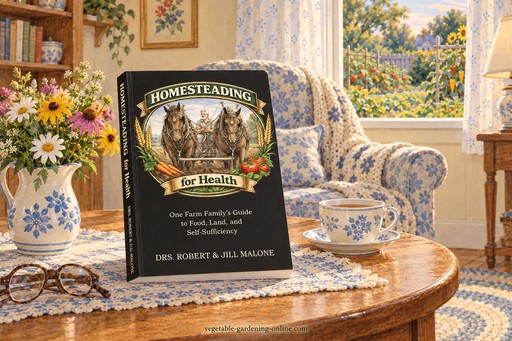 Homesteading for Health by Drs. Robert and Jill Malone.
For a much deeper look at homesteading as a full lifestyle, including raising livestock, rebuilding soil, and growing for nutrient density, Homesteading for Health by Dr. Robert W. Malone and Jill Glasspool Malone draws on four decades of the authors' own experience running working farms.
It happens to be written by the same Dr. Malone whose Substack introduced a reader to this site not long ago, which feels like a fitting connection for this page.
For the vegetable-growing side of homesteading specifically, our guides to raised bed gardening and organic vegetable gardening are good next stops.
Explore more: Organic Vegetable Garden | Raised Bed Vegetable Garden | No-Dig Vegetable Gardening | Preserving Garden Vegetables
Source: Homesteading for Health by Robert W. Malone and Jill Glasspool Malone

Recent Articles


-
How to Grow Cabbage
Sep 15, 26 12:33 PM
 How to Grow Cabbage: The Complete Guide from Seed to Harvest. This complete guide covers everything you need to know about how to grow cabbage.
 -
Easiest Vegetables to Grow: 15 Foolproof Crops for Beginners
Sep 15, 26 09:24 AM
 Easiest vegetables to grow for beginners - with advice on what makes each one easy, how to get started, and which vegetables are harder than they look.
 -
How to Grow Green Beans
Sep 14, 26 07:53 PM
 How to Grow Green Beans: The Complete Guide to Bush and Pole Beans. Green beans are one of the most forgiving crops a beginner can choose.
 -
Seasonal Vegetable Garden
Sep 14, 26 05:38 PM
 Seasonal Vegetable Garden — Growing Food Through Every Season
 -
Overwintering Vegetables: Fall-Planted Crops for Early Spring Harvest
Sep 14, 26 05:35 PM
 Learn about overwintering vegetables like garlic, fava beans, and onions, planted in fall to sit through winter and reward you with an early spring harvest.
 -
Free Vegetable Garden Journal— Printable Downloads for Home Gardeners
Sep 14, 26 01:51 PM
 Download our free Vegetable Garden Journal — choose a full 16-page version or simpler 7-page journal. Track planting, harvest, & garden notes season by season.
 -
Free Vegetable Garden Cut and Paste Activities for Kids Ages 5-7
Sep 12, 26 09:13 PM
 Free printable vegetable garden cut and paste activities for kids ages 5-7. Build your own garden, match seeds to plants, and learn what grows where.