- Home
- Children's Corner
- Vegetable Go Fish Card Game
Free Vegetable Go Fish Card Game —
Print, Cut, and Play!

Our free printable vegetable go fish card game turns vegetable learning into genuine playtime.
Children play the classic Go Fish card game — but instead of numbers or letters, each card features a beautiful illustrated vegetable.
Asking "Do you have a kohlrabi?" or "Go Fish for a butternut squash!" teaches vegetable names naturally through the rhythm and repetition of the game itself.
No studying required — the vegetable go fish card game does the teaching through play.

This vegetable go fish card game is part of the Kids Garden Club series from Vegetable Gardening Online.
Two complete printable sets cover 24 different vegetables.
Each set gives you 48 playing cards — four of each vegetable — which is exactly the right number for a proper Go Fish game.
Both sets are free to download, print, and use as many times as you like at home, in the classroom, or in a garden education program.
The Vegetable Go Fish Card Game —
Two Complete Sets

Our vegetable go fish card game comes in two sets, each covering a different group of vegetables. Together they introduce children to 24 vegetables through play.
Vegetable Set 1 of our vegetable go fish card game (KG-GF-001, Ages 3-5) covers 12 of the most familiar vegetables: tomato, carrot, bell pepper, corn, cucumber, peas, lettuce, eggplant, potato, onion, garlic, and green beans. These are the vegetables children encounter most often at home and in the garden, making this the natural starting point for the vegetable go fish card game.
Vegetable Set 2 of our vegetable go fish card game (KG-GF-002, Ages 3-5) introduces 12 less common but equally important vegetables: broccoli, cauliflower, summer squash, zucchini, beets, turnips, Brussels sprouts, kohlrabi, sweet potato, butternut squash, asparagus, and artichoke.
This set of the vegetable go fish card game introduces children to vegetables they may never have encountered before.
Kohlrabi and artichoke are often completely new to young children — the vegetable go fish card game is sometimes the first place a child hears those names.
Fruit Go Fish Card Game

Our fruit go fish card game set (FGF-003, Ages 6-8) covers 12 fruits from the garden and orchard: apple, banana, grapes, orange, peach, pineapple, watermelon, strawberry, cherry, blueberry, pear, and kiwi.
The fruit set introduces children to fruits they eat regularly while teaching the names in a playful, low-pressure game format.
Each fruit is beautifully illustrated with its characteristic colors and shapes — children learn to distinguish a peach from an orange, a pear from an apple, and a kiwi from a plum through the repeated handling and matching of the cards.
The fruit set works especially well combined with the vegetable go fish card game for a larger group or a mixed fruit-and-vegetable game session.
Berry Go Fish Card Game

Our berry go fish card game set (BGF-001, Ages 6-8) is our most botanically adventurous set — and potentially our most educational.
The 12 berries covered include familiar favorites like strawberry, blueberry, raspberry, and blackberry alongside varieties that even many adults have never heard of: red currant, black currant, gooseberry, boysenberry, cranberry, elderberry, honeyberry, and cloudberry.
This berry set is genuinely exciting for children who love discovering new things. Honeyberry and cloudberry in particular are likely to spark curiosity — "What is that?" is exactly the right response for a learning game.
We have honeyberries, gooseberries, red and black currents, and elderberries in our garden. They are not so commonly grown in this area, but are a great addition to any garden.
My husband is from Sochi, Russia, and all of these types of berries are grown and appreciated there.
Teachers who run school garden programs that grow unusual fruits will find this set pairs perfectly with a garden tasting experience.
Families who grow their own berries will recognize many of the varieties from their own gardens.
The berry go fish card game set also connects naturally to the berry-growing guides on this site for families who want to follow up the game with real garden learning.
Flower Go Fish Card Game

Our flower go fish card game comes in two sets covering 24 garden flowers in total — a complete introduction to the most beautiful and important flowering plants in the home garden.
Both sets are designed for Ages 5-8 and use the same format as the vegetable go fish card game, with four cards of each flower giving 48 cards per set.
This "Go Fish" game was suggested by my 14 year old grandson, who regrettably doesn't know the names of most flowers in our garden, and wishes he had learned them earlier!
Flower Set 1 (FGF-001) covers 12 flowers: sunflower, daisy, tulip, rose, lily, marigold, zinnia, sweet pea, pansy, coneflower, daffodil, and petunia.
These are among the most commonly grown garden flowers and the ones children are most likely to recognize from gardens, parks, and flower shops.

Flower Set 2 (FGF-002) covers 12 more flowers: iris, peony, hydrangea, black-eyed Susan, lavender, poppy, hollyhock, dahlia, gladiolus, sunflower, coneflower, and forget-me-not.
This second flower set introduces children to cottage garden favorites and wildflower species they may not have encountered by name before. Hollyhock and forget-me-not are perennial favorites with children once they learn the names.
The flower sets have an important educational connection beyond pure vocabulary — many of the flowers shown are important for pollinators.
Marigolds, coneflowers, lavender, black-eyed Susans, and sweet peas are all beloved by bees and butterflies.
The flower go fish card game becomes a natural jumping-off point for conversations about why flowers matter for the garden ecosystem.
How to Play the Vegetable Go Fish Card Game

All six sets of our vegetable go fish card game follow the same classic Go Fish rules.
The vegetable go fish card game works best with two to four players.
- Print one complete set.
- Cut all the cards apart along the dotted lines.
- You will have 48 cards — four of each plant.
- Shuffle the deck.
- Deal 7 cards to each player.
- Place the remaining cards face down in the center as the draw pile.
- Players take turns asking any other player for a specific card they need. "Do you have a tomato?"
- If that player has the card, they hand it over.
- If not, they say "Go Fish!" and the asking player draws from the pile.
- When a player collects all four cards of one plant, they lay the set face up on the table.
- The player with the most completed sets when all cards are matched wins.
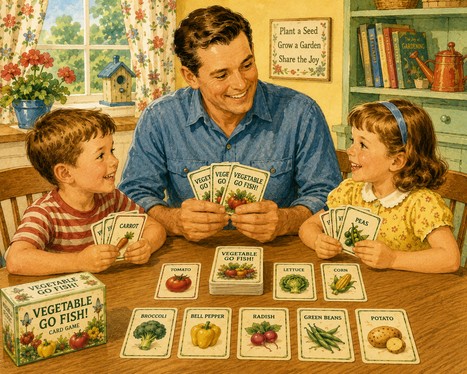 Family time with a friendly "go fish" game.
With younger children, deal only five cards each.
For a larger group or a longer game, combine two sets together — the vegetable and fruit sets make a natural pairing, giving you 24 plants and 96 cards.
For very young children playing any set for the first time, set the goal at matching pairs (two cards) rather than sets of four.
This makes the vegetable go fish card game faster and more successful for children who are still learning card game concepts.
Printing Tips for the Go Fish Card Game Sets

Print on cardstock or print on regular copy paper and then laminate, for the best results with any go fish card game set. Cardstock is sturdy enough to shuffle and handle without bending.
For classroom use where sets will be used repeatedly, laminate the printed sheet before cutting.
Laminated cards feel like real playing cards and last for years.
Print in full color for the most engaging version — the illustrations are designed in color and the vegetable names appear in color-coded text that helps children distinguish cards quickly.
A black and white version also works well and prints more economically.
Children can color the cards themselves before playing, adding a creative activity before the game begins.
Store each completed set in a small zip-lock bag or a playing card box. Label each bag with the set name and age range so you can find the right set quickly.
More Free Kids Garden Club Printables

Our go fish card game sets are part of a growing library of free Kids Garden Club printables.
We also offer vegetable flash cards covering 32 vegetables, garden scavenger hunts in three grade levels, cut and paste garden activity sets, coloring books, mazes, dot-to-dot pages, word searches, and bookmarks.
For vocabulary-building that complements the vegetable go fish card game, our vegetable flash cards are the natural companion — use the flash cards for recognition practice, then reinforce vocabulary through the fun of the game.
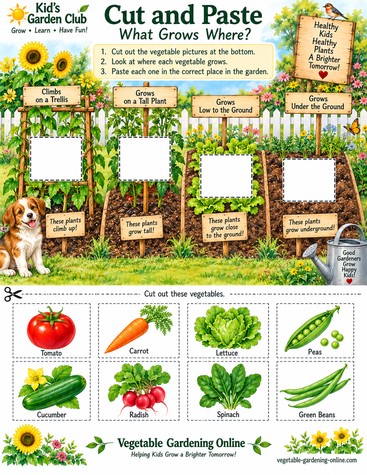
Want another activity for the same age group? Our Vegetable Garden Cut and Paste Activities offer seven more ways to learn about the garden through hands-on play.
For ideas on game-based learning with young children, PBS Kids for Parents at pbs.org/parents has excellent resources on how card games build vocabulary, memory, and social skills in early elementary children.
- Vegetable Flashcards Printable — free vegetable flash cards covering 32 vegetables; pairs perfectly with the Go Fish card game sets
- Garden Scavenger Hunt Printable — free garden scavenger hunt in three grade levels for outdoor garden vocabulary learning
- Vegetable Garden Coloring Books — free printable coloring pages and coloring books for children
- Free Worksheets for Kids — mazes, dot-to-dots, word searches, bookmarks, and activity pages
- Kids Gardening — complete hub for children's gardening activities and free printables
- Free Vegetable Garden Printables — all our free downloads in one place
PBS Kids for Parents —
Card Games and Play-Based Learning

For ideas on using card games and play-based activities to build vocabulary and thinking skills in young children — including how games like the vegetable go fish card game develop memory, strategic thinking, and social skills alongside content learning — PBS Kids for Parents at pbs.org/parents has excellent resources on game-based learning for home and classroom use.

Recent Articles


-
How to Grow Cabbage
Sep 15, 26 12:33 PM
 How to Grow Cabbage: The Complete Guide from Seed to Harvest. This complete guide covers everything you need to know about how to grow cabbage.
 -
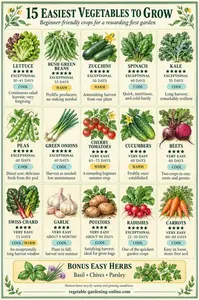
Easiest Vegetables to Grow: 15 Foolproof Crops for Beginners
Sep 15, 26 09:24 AM
 Easiest vegetables to grow for beginners - with advice on what makes each one easy, how to get started, and which vegetables are harder than they look.
 -
How to Grow Green Beans
Sep 14, 26 07:53 PM
 How to Grow Green Beans: The Complete Guide to Bush and Pole Beans. Green beans are one of the most forgiving crops a beginner can choose.
 -
Seasonal Vegetable Garden
Sep 14, 26 05:38 PM
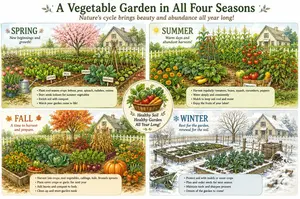
 Seasonal Vegetable Garden — Growing Food Through Every Season
 -
Overwintering Vegetables: Fall-Planted Crops for Early Spring Harvest
Sep 14, 26 05:35 PM
 Learn about overwintering vegetables like garlic, fava beans, and onions, planted in fall to sit through winter and reward you with an early spring harvest.
 -
Free Vegetable Garden Journal— Printable Downloads for Home Gardeners
Sep 14, 26 01:51 PM
 Download our free Vegetable Garden Journal — choose a full 16-page version or simpler 7-page journal. Track planting, harvest, & garden notes season by season.
 -
Free Vegetable Garden Cut and Paste Activities for Kids Ages 5-7
Sep 12, 26 09:13 PM
 Free printable vegetable garden cut and paste activities for kids ages 5-7. Build your own garden, match seeds to plants, and learn what grows where.