- Home
- Children's Corner
- Bean in a Jar Experiment
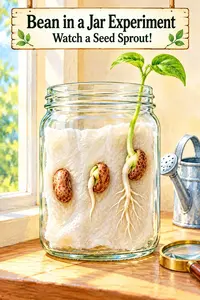
Bean in a Jar Experiment for Kids
The bean in a jar experiment for kids is one of the easiest science activities you can do at home. All you need is a jar, a paper towel, and a few dried beans. Your first block of text...
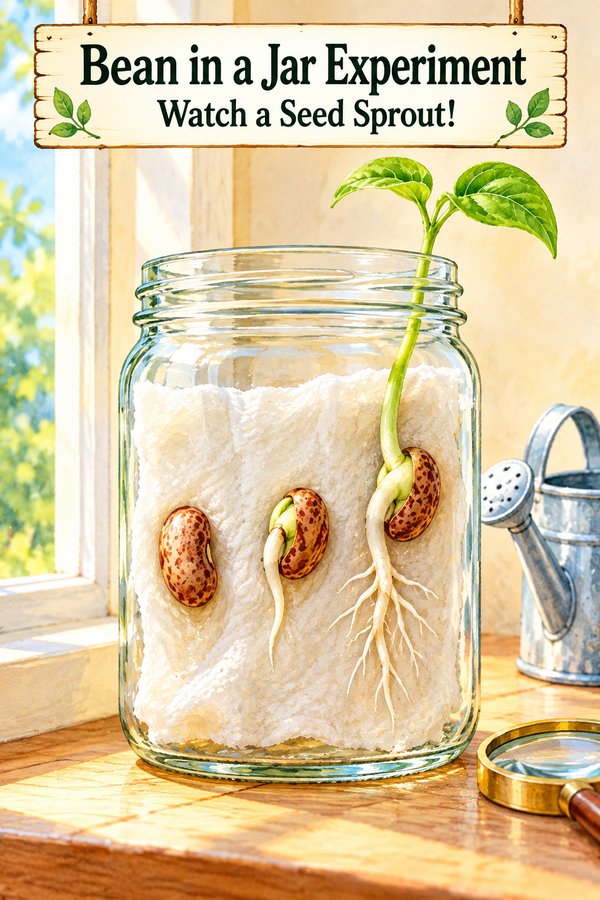
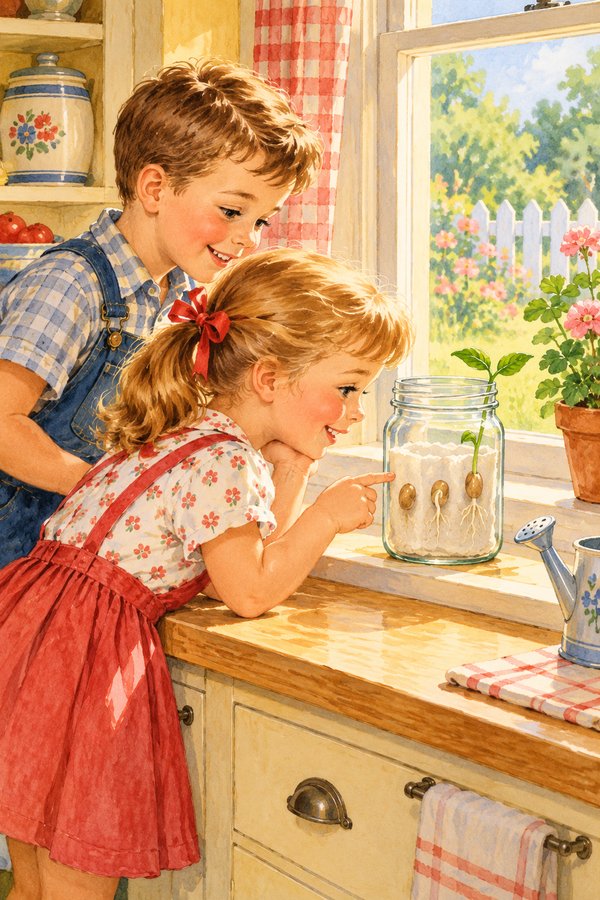
Because the beans grow against the glass, children can watch what usually happens underground.
The seed swells, a root pushes down, and a green shoot reaches up toward the light. Your second block of text...
It works any time of year, so it's a perfect indoor fall or winter project for homeschool, the classroom, or a rainy afternoon at the kitchen table.
Most beans sprout in just a few days, so even young children stay excited from start to finish.
What You Will Need for the Bean in a Jar Experiment
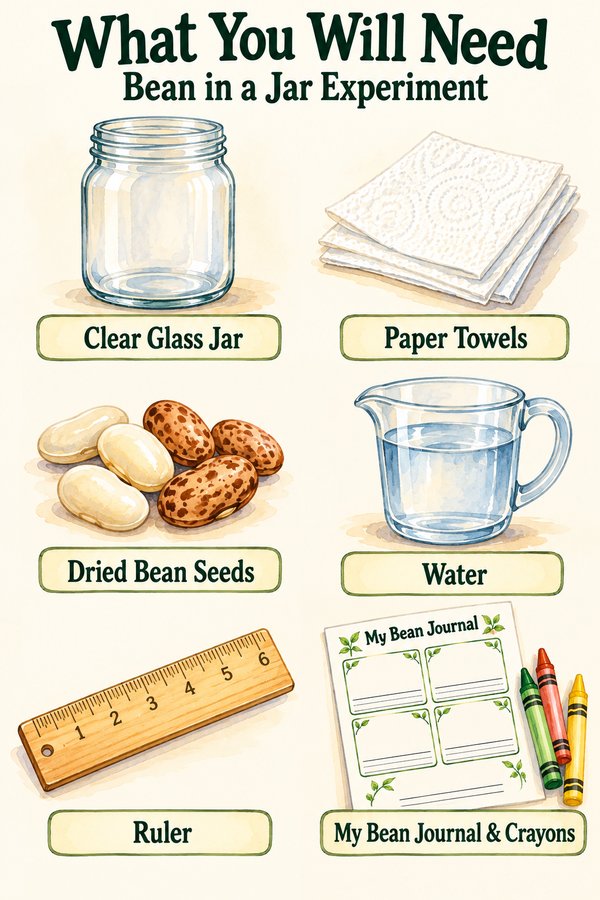
- A clear glass jar. A pint canning jar or an empty pickle jar works well. A clear plastic cup is safer for little ones.
- Paper towels. Two or three sheets, folded to fit inside the jar.
- Dried bean seeds. Large lima beans are the easiest to watch. Pinto beans and bean seeds from a garden seed packet work too. Dried beans from the grocery store usually sprout fine.
- Water. Enough to keep the paper towel damp.
- A ruler. For measuring how tall the sprout grows.
- My Bean Journal and crayons. Our free printable, below, for drawing what you see.
How to Do the Bean in a Jar Experiment
- Soak the beans overnight. Put 4 or 5 beans in a bowl of water before bedtime. Soaking softens the seed coat so they sprout faster.
- Line the jar. Fold the paper towels and press them around the inside of the jar, against the glass.
- Wet the paper towel. Pour in a little water so the towel is damp all over, then pour off the extra. It should be wet, but the beans should not sit in a puddle.
- Tuck in the beans. Slide 3 or 4 beans between the paper towel and the glass, about halfway down, spaced apart so each one is easy to see.
- Find a warm spot. Set the jar on a windowsill or counter that is warm but not in hot, direct sun.
- Check every day. Add a few drops of water whenever the towel starts to dry out. Draw what you see in your bean journal.
What to Watch For, Day by Day
- Day 1 to 2: The beans swell up as they drink in water, and the seed coat may wrinkle or split.
- Day 3 to 4: A small white root pokes out and grows downward.
- Day 5 to 7: Tiny side roots branch out, and a curved shoot starts growing up toward the light.
- Day 7 to 10: The shoot straightens, and the first green leaves open. Measure it with your ruler!
Every bean grows at its own speed, so don't worry if yours are a day or two ahead or behind.
Free Printable: My Bean Journal
Kids draw their bean on Day 1, 3, 5, 7, and 10, write a few words about what changed, and measure how tall it grew. It's made for grades K-2.
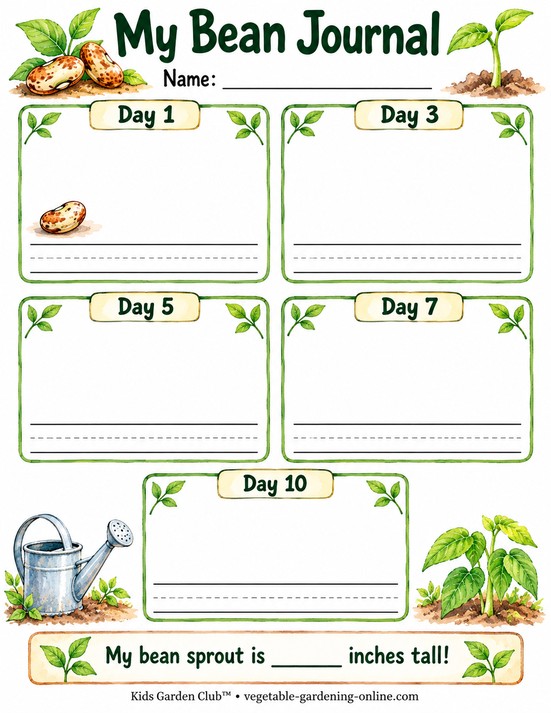
Click here to print My Bean Journal (free PDF)
Try These Bean Experiments Next
- Light or dark? Start two jars and put one in a dark cupboard. Do both beans sprout? Which one stays green?
- Turn it upside down. Once the root is about an inch long, gently turn the jar on its side. In a day or two, the root bends to grow down again.
- Plant it outside. When the first leaves open, move your sprout into a pot of soil and watch it grow into a real bean plant.
Bean in a Jar Questions
How long does it take a bean to sprout in a jar?
Most beans grow a root in 3 to 4 days and green leaves in about 7 to 10 days. Soaking the beans overnight first and keeping the jar warm helps them sprout faster.
Why didn't my beans sprout?
The paper towel may have dried out, the spot may be too cold, or the beans may be too old. Try fresh beans, keep the towel damp, and move the jar somewhere warmer.
What if my beans get moldy?
A little fuzz means the jar is too wet. Throw out moldy beans, use a fresh paper towel, and add less water next time.
Can kids eat the beans?
No. Raw dried beans are not safe to eat, so remind children these beans are for growing, not snacking. Grown-ups should help younger children, since beans are small enough to be a choking hazard.
More Free Garden Activities for Kids
Learn the whole story of a plant with our free plant life cycle worksheet, read along with Ben's Year in the Vegetable Garden, or find more free garden worksheets for kids.
For another hands-on seed activity, see Penn State Extension's Mighty Seed activity.

Recent Articles


-
Bean in a Jar Experiment for Kids + Free Printable Bean Journal
Oct 01, 26 10:02 AM
 Try the bean in a jar experiment with your kids and watch roots and shoots appear day by day. Easy seed science with a free printable bean journal for K-2.
 -
Planning a Vegetable Garden Layout: Free 20x40 Plan and Online Planner
Sep 30, 26 02:38 PM
Planning a vegetable garden layout step by step: pick a garden type, download the free 20x40 plan, lay out beds in the free online planner, and build the soil. -
Vegetable Garden Layout Ideas: 11 Designs That Work for Any Space
Sep 30, 26 10:19 AM
 Vegetable garden layout ideas for any space: raised beds, square foot, rows, vertical, salad, Three Sisters, containers, keyhole, no-dig, and knot gardens.
 -
Free Vegetable Garden Cut and Paste Activities for Kids Ages 5-7
Sep 29, 26 05:29 PM
 Free printable vegetable garden cut and paste activities for kids ages 5-7. Build your own garden, match seeds to plants, and learn what grows where.
 -
Free Preschool Vegetable Garden Cut and Paste Activities
Sep 29, 26 03:12 PM
 Free preschool vegetable garden cut and paste activities for ages 3-4. Build your own backyard, container, or seed packet garden scene, and sticker sheets.
 -
Preschool Art Activities: Free Garden Crafts and Coloring Pages
Sep 29, 26 03:00 PM
Free preschool art activities with a garden theme: vegetable coloring pages, a seed packet craft, and paper plate scarecrows to print for home or school. -
Raised Bed Vegetable Garden: Plans, Layouts, and How to Build One
Sep 27, 26 09:37 PM
 A raised bed vegetable garden step by step: where to put it, size and depth, materials, how to build and fill it, a free 4x8 planting plan, and what to grow.