Small Vegetable Garden
Plans and Ideas
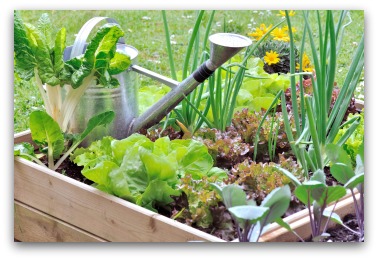
Thinking of starting a small vegetable garden at home? Here are a few easy tips and ideas to help you plan!
Square foot, container and other small plot garden plans are perfect for growing vegetables when space or time are limited.
Planning and planting a small garden is a very wise decision in today's economy.
Not only can you save money and eat better food, but learning how to provide for your family without depending on outside sources is practical and prudent.
Small Vegetable Garden Ideas
Here are some great examples of small veggie gardening plans.
A container garden can be the perfect solution, or a beautiful patio garden can provide an abundance of fresh vegetables.
Vegetable plants can also be added to an existing sunny border or flower bed!
The only limitation is your imagination, and of course, finding a sunny location for your garden.
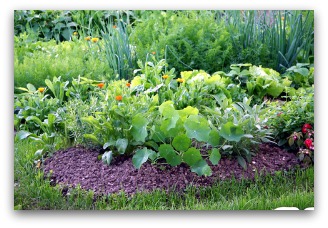
Easy DIY One-Day
Small Garden Plan
Growing your own tomatoes, lettuce, cucumbers, carrots, peppers and more is easily done in even the smallest garden spaces.
A DIY raised bed can be the perfect fit for many gardening needs.
They can be quite attractive with a little creativity applied to the design and materials...
Design Your Own Vegetable Garden Layout Using our Free "Vegetable Garden Planner" Software!
Square Foot Gardening--A Smart Way to Start
a Small Vegetable Garden
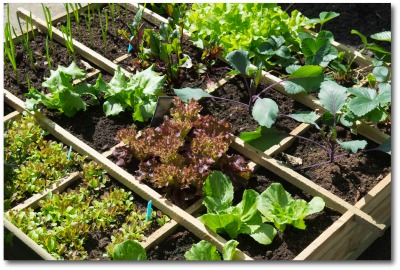
Even if you don't have a huge backyard, with a little creativity you can build a raised bed or container garden in sunny location in your yard or on your patio, porch, deck, or balcony.
Can’t you just taste the plump juicy tomato and the sweet juicy carrots?
Download Free Garden Planning Worksheets, Garden Diary, Zone Chart, Or Planting Guide
Before you attempt to grow the area’s largest pumpkin or zesty collards, and are short on space and time, take a look at some creative small vegetable garden plans.
Beginner vegetable gardens come in all shapes and sizes; large, small, and in-between.
In a crowded landscape, your garden may have to take a sharp bend, form a semi-circle, or be placed in a flower bed, or on the patio.
So be creative!
Let’s take a look at some small space vegetable garden plans.
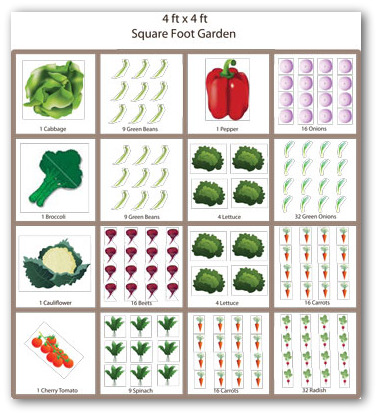
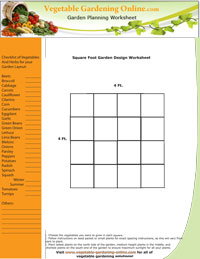
Click Here to Download Sample "Square Foot" Garden Design
Intensive planting designs use every bit of garden space available.
Square foot gardens (4 ft. by 4 ft.) are surprisingly productive.
You will want to plan on one four by four square foot garden for each
member of your family if you want to grow most or all of your own
vegetables.
- To build a square foot garden, use untreated lumber (either 2 by4's, or 2 by 6's will work fine) cut into 4' 3" lengths.
- Nail or stake the ends together to create a square with an inner area of four feet.
- Divide the square into 16 equal squares, using strips of wood or string as dividers.
Several plants may be planted in rows, smaller squares, or at random in the small vegetable plots.
For instance, fill one square with four bean plants.
Divide the area into smaller squares and plant one seed in the middle of each.
A square can hold 36 radishes or 16 onions. The seeds can be scattered across the square or sown in small rows.
Harvest early by thinning out young plants for use as tender greens or roots, creating room for the rest to grow.
Trellises add a third dimension to small vegetable garden plans.
- A trellis is useful to gardeners seeking to maximize space.
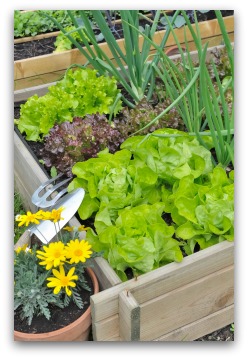
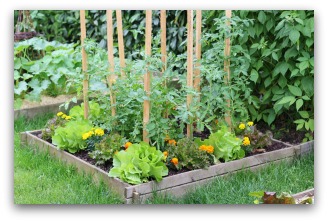
Cages also can be used to take advantage of vertical space and keep crops from sprawling over the ground.
Many plants can be successfully grown in cages, including tomatoes, watermelons, and eggplants.
In addition to space-saving planting techniques, gardeners have an additional resource: dwarf varieties and bush forms of plants that originally grew only as vines!
Be advised, while the dwarf varieties take up less garden room, the harvests are somewhat smaller than their full size relatives.
Geometric planting patterns make maximum use of space in small vegetable garden plans.
Gardeners use simple designs to fill wide beds with vegetables.
As they say, necessity is the mother of invention!
Spacing Vegetables in
Small Plot Gardens

- Beans are a sure producer and should be spaced four plants per square foot in small vegetable garden plans.
- Broccoli, Brussels sprouts, peppers, and eggplant may need staking and space 1 plant each square foot.
- Cabbage and cauliflower produces a single head planted at one to a foot.
- Trellis or stake tomatoes at one plant per square foot.
- Make successive plantings of endive, kohlrabi, and lettuce, at four plants per square foot.
- Harvest individual leaves of kale and parsley spacing four plants per square foot.
Container Vegetable Gardens

- Another great way to grow a small garden is in containers.
- Choose a sunny location for your container garden!
- Use recycled medium and large size containers, or purchase plastic, clay or ceramic pots online or from your local garden center.
- Fill your containers with a good quality potting soil with compost and fertilizer already added.
Vertical Gardening Suggestion

- Use cages or trellises to support larger-growing vegetables such as tomatoes, cucumbers and peppers.
- A single stake will support floppy, low growing plants that might otherwise be injured by winds or abundant production.
- A wire cage gives the best support for tall-growing plants.
- Don’t think just because you have small vegetable garden plans that means not much of a harvest.
- Vegetable gardening even on a smaller scale can produce bumper crops.
- In fact, with vertical gardening, the sky is the limit!
These are just three easy ways for planning and growing a small vegetable garden.
There are many more possibilities that may work for you.
You will be surprised how fun and fulfilling it is to have your own vegetable garden.
Gardening is a great hobby and life-skill for the whole family to learn and enjoy.
So have some fun, and enjoy the gardening experience.
Each garden you grow will be a new opportunity for creativity and learning!
You Might Also like to Read:
Recent Articles


-
Growing Dill In a Backyard Vegetable Garden
Nov 20, 18 11:40 PM
 Easy tips for growing dill in a home vegetable, kitchen, or herb garden. Learn how to plant, grow, care for, and harvest dill plants when backyard vegetable gardening.
 -
Vegetable Garden Pictures to Help Plan Your Garden
Nov 20, 18 09:53 AM
 Vegetable garden pictures and videos to help you get started planting a garden. Gardening pictures can help you plan your garden whether a raised bed, container, or traditional backyard home garden.
 -
Vegetable Gardening Planting Times, Zone Chart, and Guide for When to Plant
Nov 20, 18 09:51 AM
Use our free zone chart and guide for vegetable gardening planting times, to plan your next garden. Whether planting seeds or transplants, learn when to start.