How to Store Onions from Your Vegetable Garden
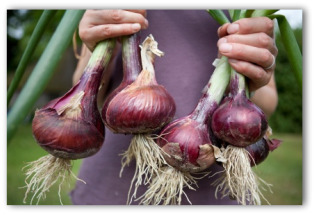
Learn how to store onions from your vegetable garden for best storage results!
Here are a few easy tips for harvesting, preparing and storing home-grown onions for the winter.
By proper planning and making use of seeds, sets, and transplants, it is possible to produce fresh onions for use six to eight months of the year.
Design Your Own Vegetable Garden Layout Using our Free "Vegetable Garden Planner" Software!
By learning how to store onions, you can fill the remaining months with your own home-grown produce.
Now, you can't really extend the season any longer than that!
The year-long production of onions is accomplished by planting spring and summer onions with late finishes in the fall.
Onion Varieties That Are Best for Storage

The onions you will be harvesting in the fall as the season winds down are the ones you will store in the pantry for winter use.
Storage onions are usually started from sets in March or two months before the last frost date.
They begin forming bulbs when daylight duration lengthens to reach 16 hours.
Download Free Garden Planning Worksheets, Garden Diary, Zone Chart, Or Planting Guide
Storage onion varieties include: Yellow Globe, Downing Yellow Globe, Yellow Globe Danvers, and Ebenezer.Earlier maturing storage onions are: Orbit, Copra, and Early Yellow Globe.
White storage onions like Southport White Globe should be stored only if their necks are small.
Red storage varieties include Southport Red Globe and Wethersfield.
Harvesting Onions

Onions may be eaten at any stage.
Young green stems are harvested as scallions when the bases begin to bulge.
Harvesting mature bulbs in late spring can begin after the leaves on more than half of the plants fall or bend over.
Harvest by gently loosening the bulbs from the soil and spread them out in an airy location away from direct sunlight.
This will allow the skins to harden. Keep the produce in a spot with low humidity to extend shelf life.
Vegetable Gardening Tips for Storing Onions
- Winter keepers are calculated to flavor a robust stew and are welcomed when storms are howling outside and nothing else is producing in the vegetable garden.
- Certain onion plant varieties store better and longer than others. The late season onions are the best keepers.

How to Store Onions
Onions should be kept in cool, dark, and dry conditions.
The ideal temperature would be somewhere between 40 and 50 degrees.
A good place for storing onions is in a root cellar or dark corner of the garage.
Stored onions require ventilation as well.
You can use a mesh bag for storing the bulbs or a pair of panty hose.
Slip the onions into the hose and tie a knot between each bulb.
They will get the air needed through the stockings.
When you need to use an onion from the stocking, cut below the knot using a pair of scissors.
Twist ties may also be used between each onion instead of tying knots.
Storing Onions

Leave the leaves intact and allow them to dry in an airy space for several weeks.
When the outer skins have completely dried, you can either braid the stems together or cut them to around an inch above the bulb.
Place them in an airy container such as a wire basket. If plaited, hang the stored onions in a cool, dry area.
If the location is too warm then sprouting will occur. When the area is damp or colder than freezing, the onions will rot or become damaged.
It is okay to eat an onion that has sprouted if you chop into a stored onion and find a green center.
Just slice off the sprout and remove the green part.
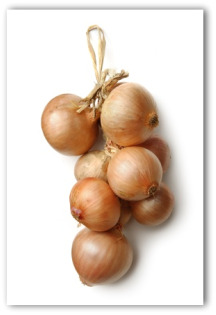
If the onion is slimy or discolored, do not take any chances eating it and throw it on the compost pile instead. You will have plenty more to choose from since you learned how to store onions properly.
Save extra bulbs of shallots and multiplier onions to plant in the cool fall season if your climate area permits.
As the season comes to an end, even without fresh crops from the garden, you will still have plenty of produce since discovering how to store onions, you may never need to shop for store bought onions again!
You Might Also like to Read:
Growing OnionsRecent Articles


-
Growing Dill In a Backyard Vegetable Garden
Nov 20, 18 11:40 PM
 Easy tips for growing dill in a home vegetable, kitchen, or herb garden. Learn how to plant, grow, care for, and harvest dill plants when backyard vegetable gardening.
 -
Vegetable Garden Pictures to Help Plan Your Garden
Nov 20, 18 09:53 AM
 Vegetable garden pictures and videos to help you get started planting a garden. Gardening pictures can help you plan your garden whether a raised bed, container, or traditional backyard home garden.
 -
Vegetable Gardening Planting Times, Zone Chart, and Guide for When to Plant
Nov 20, 18 09:51 AM
Use our free zone chart and guide for vegetable gardening planting times, to plan your next garden. Whether planting seeds or transplants, learn when to start.