Tips for Growing Large
Onions in the Garden
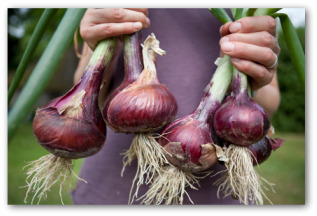
Here are a few great tips for growing large onions when backyard vegetable gardening!
Learn which onion varieties are best when you want to plant and grow large onions in your garden.
Design Your Own Vegetable Garden Layout Using our Free "Vegetable Garden Planner" Software!
Provided with good soil preparation, little seasonal care is needed for onions.
To grow a highly satisfactory crop, just give the plants what they need, and they will handle the rest.
Come harvest time, you won't be shedding tears over the loss of your crops!
Large onions are finicky about the soil they grow in.
- The plants prefer fertile, loose, friable soil that is well-drained and has lots of organic matter.
- Sandy loams are ideal garden beds for growing large onions.
- Before planting, turn in good amounts of compost or well aged manure into the garden bed.
Best Varieties for Growing Large Onions
If you have ever been anywhere in the South, you have probably heard of Sweet Vidalia onions.
By federal law, to be considered a Vidalia onion, the crops must be grown within 75 miles of Vidalia, Georgia.
However, sweet onions can be grown in other states.

Download Free Garden Planning Worksheets, Garden Diary, Zone Chart, Or Planting Guide
The key to growing sweet onions is soils, variety, and stress.
The pungency of onions is controlled by sulfur containing compounds in the soil.
To produce sweet tasting onions, soils must be low in sulfur, a type of onion should be chosen which does not gather sulfur, and throughout its growth period, the crops must be allowed to be stressed for nutrients or water.
Yellow Granex
Another sweet, mild onion from Vidalia, Georgia is the Yellow Granex.
This is an excellent onion for all warm regions, although your crop may be slightly stronger tasting than those grown in the peach state.
Sweet Spanish
Sweet Spanish keeps well, lasting into midwinter.
This red onion, which also has a white counterpart, is globe shaped and grows very large.
They are mostly mild and often weigh two pounds.
Torpedo
The Italian bottle onion, which is sometimes called Torpedo has large bulbs and is mildly flavored.
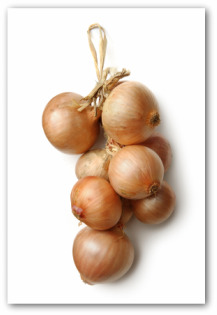
Giant of Zittau
The Dutch have a large onion called Giant of Zittau.
Besides being large sized, it is the longest keeper of all.
If you live in a climate where onion crops have to be planted in late spring and are not harvested until fall, it might be of advantage to grow a long keeper.
Stuttgarter Giant is also imported from the Netherlands.
It is simply delicious when used fresh for cooking or salads and is ideal for storage.
Walla Walla Onions
The Walla, Walla onions are big as softballs and have been popular for more than a century.
This is a giant sized onion that everyone can grow, even in northern gardens.
It is so sweet, juicy, and crunchy; it could be eaten like an apple.
Tastes great served fresh in salads or on hamburgers.
Not all onions store equally well.
Sweet onions such as these should be used within a few weeks of harvesting.
In many areas, late summer and fall seeding or planting is a general rule for onions.
Another full-sized variety is the English import, Ailsa Craig.
This huge white onion variety is pear shaped.
The bulbs can be over four inches in diameter.
Best if used when freshly picked but can be stored for several months.
Planting Onions from Sets, Seedlings, or Seeds
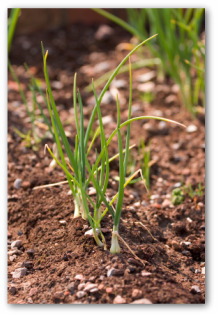
Onions can be planted from seeds, seedlings, or small onions called "sets".
- If you want to grow large onions in one season, it is best to start your onion crop from sets or seedlings.
- Plant the onion sets in the garden in late spring, in well-prepared compost-enriched garden soil.
- Onion sets should be planted about 1 inch deep.
- The rows should be spaced about 16" apart.
- You can plant the sets fairly close together in the rows, as you can thin some of the green onions out of the rows as they grow, and let the remaining onions develop into large onion bulbs.
Seeds to Seedlings
- Growing large onions from transplants is also works well.
- You can grow the onion seedlings yourself from seeds planted indoors about 2 months before it is time to plant outdoors in your area, or you can purchase the seedlings from a local garden center or online.
- Onion transplants or seedlings work well for growing large onions in your garden.
- Your local nursery can tell you which varieties of onions will grow best in your area.
Caring for Growing Onions
Their shallow root systems make onions sensitive to fluctuations in soil moisture.
Though the onion plants do not need a whole lot of water, regular watering every week is required. Mulching controls weeds and maintains soil moisture.
Onions do not require a lot of nutrients, but their root systems are so small, they need to grow in highly fertile soil to absorb what they do need.
In late spring, side dress the growing large onions with compost.
If needed, apply an organic fertilizer such as fish emulsion once a month.
Do not overdose on nitrogen because too much will produce lots of leaves but small bulbs.
Recent Articles


-
Growing Dill In a Backyard Vegetable Garden
Nov 20, 18 11:40 PM
 Easy tips for growing dill in a home vegetable, kitchen, or herb garden. Learn how to plant, grow, care for, and harvest dill plants when backyard vegetable gardening.
 -
Vegetable Garden Pictures to Help Plan Your Garden
Nov 20, 18 09:53 AM
 Vegetable garden pictures and videos to help you get started planting a garden. Gardening pictures can help you plan your garden whether a raised bed, container, or traditional backyard home garden.
 -
Vegetable Gardening Planting Times, Zone Chart, and Guide for When to Plant
Nov 20, 18 09:51 AM
Use our free zone chart and guide for vegetable gardening planting times, to plan your next garden. Whether planting seeds or transplants, learn when to start.