- Home
- Vegetable Garden Care
- Ornamental Garden Fence
Ornamental Garden Fence
for Your Home Garden
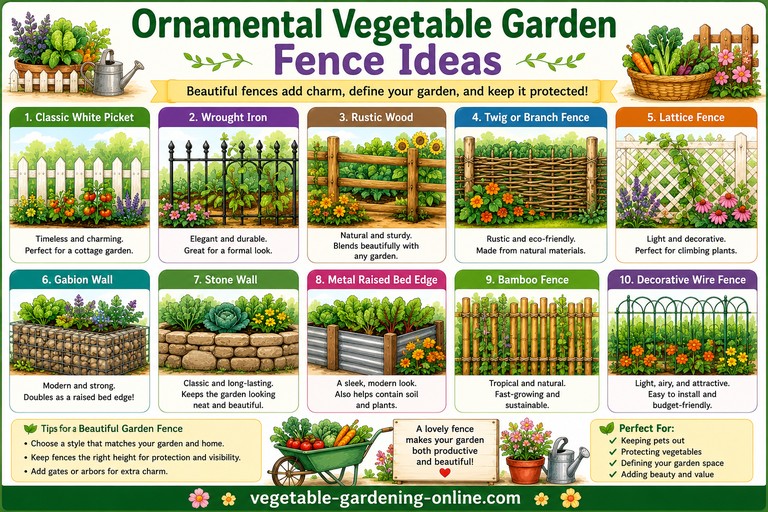
Here are a few ornamental garden fence ideas if you want to contain your garden and keep out unwanted pests!
These examples show plans and ideas for creating an attractive vegetable garden fence.
Garden fences can also serve the purpose of offering some protection during windy weather, and can offer climbing plants a built-in trellis.
An attractive garden fence also offers some cover during the less attractive stages of vegetable gardening.
If you are handy at do-it-yourself projects, building a fence for your garden can be a fun weekend project.
Metal or Wrought Iron Ornamental Garden Fence

When many gardeners envision a decorative garden fence, it reminds them of the typical English gardens.
Often made from aluminum or wrought iron, the decorative fences provide a backdrop to show off your eye-pleasing and tasteful garden fence.
Surrounding your property is a good idea if you have a problem with encroaching neighbors such as deer or wild hogs.
Make certain the fence is of sufficient height and designed with the pickets close enough to keep the type of wild animals known to roam in your area out.
Many ornamental fences are decorated with pointed picket tops that serve a dual purpose of discouraging would be intruders from climbing over the fence.
Picket tops are normally recommended for fences over six feet high for safety reasons.
Wrought iron is an ideal choice for an ornamental garden fence because it offers structural strength along with allowing the ability to see outward.
At the same time, you are not completely blocking your neighbors or passers-by from seeing the garden space you are creating.
It can also partition your property from adjoining properties, or divide one section of your land from another.
Wooden or Vinyl Vegetable Garden Fencing Ideas

There are many types of wooden garden fences that have a decorative purpose as well as securing your garden.
These can be traditional white picket fences, lattice, or wooden boards fastened to posts.

Many traditional wooden fences have been replicated using low maintenance vinyl material.
These are a great way to eliminate the need for re-painting or staining fence boards.
A visit to your local home improvement center will reveal the many ornamental fencing options available.
Living Ornamental Garden Fence Hedges
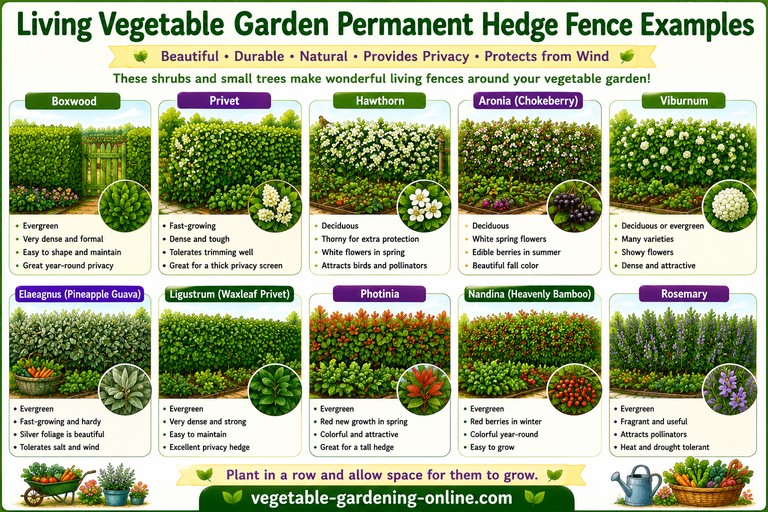 Examples of living hedges that can be planted to create an ornamental vegetable garden fence. Most are evergreen, and a few are deciduous.
Another idea for designing a distinctive ornamental garden fence is maintaining evergreen hedges around the area.
Boxwood, Pineapple Guave, Waxleaf Priving, Photinia, Nandina, and Rosemary plants can be used to create evergreen hedges. Viburnum can be used also; there are evergreen varieties. It is also dense, and has showy flowers.
Privit is fast growing, dense, and tolerates trimming well.
Hawthorne and Chokeberry are deciduous, but create a fence during garden growing season.
Surround a gardening spot using a hedge and install a wooden garden gate underneath an arbor or trellis to make a beautiful entrance-way.
Evergreen hedges are living year-round features of the landscape.
A close-set row of bushes with the branches intertwined forms a practical garden barrier or boundary to protect against loss.
In addition, a hedge helps guard against erosion, provides a habitat for birds and bees, and serves as a natural background for the garden.
The hedge may be a formidable row of tall-growing trees, a head-high wall, or a short divider in the yard.
You want hedges to grow thick, dense foliage that will be easy to trim into a desired shape or size.
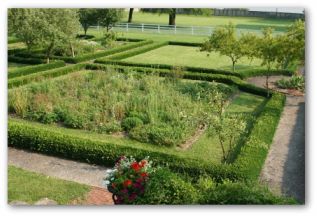
Types of hedges include slow-growing evergreen species, cypress varieties that yield a thick, fast growing hedge, boxwood, and many fir species.
They need average garden soil and plenty of sunshine.
Watered regularly while they are young, hedge plants usually require no watering once established.
Kitchen and Herbal
Gardens of Old
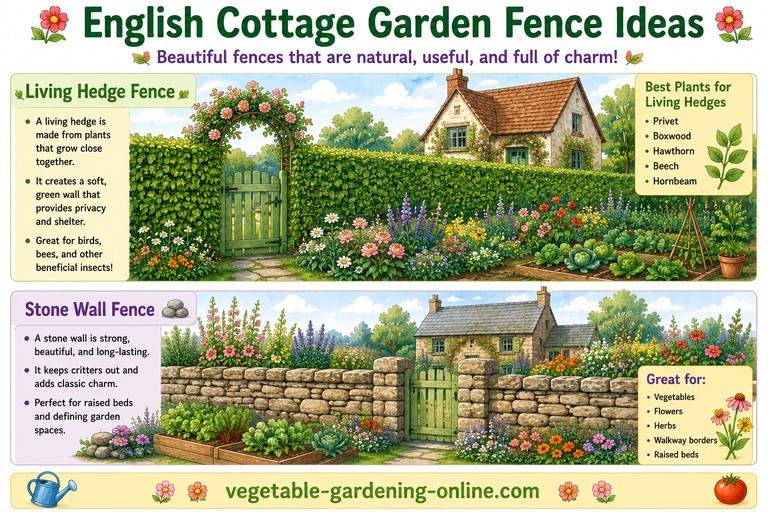 An example of two types of traditional style cottage garden fences; a living hedge fence, and a stone wall.
Medieval vegetable gardening practices included planting kitchen gardens, cemetery orchards, vineyards, and medicinal herb plots.
Frequently, the plot was surrounded with fencing that prevented unwanted animals from straying inside and helping themselves to the produce.
Now days, an ornamental garden fence serves the same purpose of security as well as providing a pleasing view.
In medieval times, the garden was laid out in rectangular beds with pathways between them, which simplified harvesting.
Then as now, if space allowed, cabbage, leeks, parsnips, fennel, onions, garlic, peas, radishes, and beans were grown for cooking purposes.
Herbal remedies for illness included: savory, rosemary, rue, peppermint, sage, mint, and cumin.
Stone walls and living hedges offered protection from weather and garden pests alike.
Stone garden walls also retained heat, and offered a lovely backdrop for climbing vegetables and ornamental plants such as roses.
Following the devastating Black Death of the mid-fourteenth century, which wiped out about a third of Europe's population, there were an insufficient number of peasants to work the landowners' gardens.
To prevent a food shortage, landlords leased small plots of land to tenant farmers so they could grow their own produce.
Historians claim that this practice led to the invention of the famous English cottage garden.
Return to our Garden Care and Maintenance hub for complete guides to vegetable garden upkeep, pest management, watering, and fencing.
- Garden Care and Maintenance — complete hub for vegetable garden upkeep, pest management, watering, and fencing

Recent Articles


-
How to Grow Cabbage
Sep 15, 26 12:33 PM
 How to Grow Cabbage: The Complete Guide from Seed to Harvest. This complete guide covers everything you need to know about how to grow cabbage.
 -
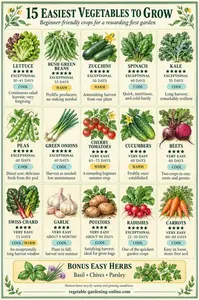
Easiest Vegetables to Grow: 15 Foolproof Crops for Beginners
Sep 15, 26 09:24 AM
 Easiest vegetables to grow for beginners - with advice on what makes each one easy, how to get started, and which vegetables are harder than they look.
 -
How to Grow Green Beans
Sep 14, 26 07:53 PM
 How to Grow Green Beans: The Complete Guide to Bush and Pole Beans. Green beans are one of the most forgiving crops a beginner can choose.
 -
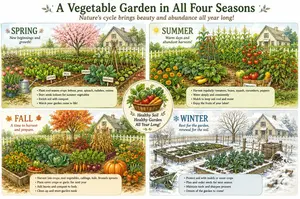
Seasonal Vegetable Garden
Sep 14, 26 05:38 PM
 Seasonal Vegetable Garden — Growing Food Through Every Season
 -
Overwintering Vegetables: Fall-Planted Crops for Early Spring Harvest
Sep 14, 26 05:35 PM
 Learn about overwintering vegetables like garlic, fava beans, and onions, planted in fall to sit through winter and reward you with an early spring harvest.
 -
Free Vegetable Garden Journal— Printable Downloads for Home Gardeners
Sep 14, 26 01:51 PM
 Download our free Vegetable Garden Journal — choose a full 16-page version or simpler 7-page journal. Track planting, harvest, & garden notes season by season.
 -
Free Vegetable Garden Cut and Paste Activities for Kids Ages 5-7
Sep 12, 26 09:13 PM
 Free printable vegetable garden cut and paste activities for kids ages 5-7. Build your own garden, match seeds to plants, and learn what grows where.