- Home
- Vegetable Garden Soil
- Compost Bin Plans
Easy Compost Bin Plans
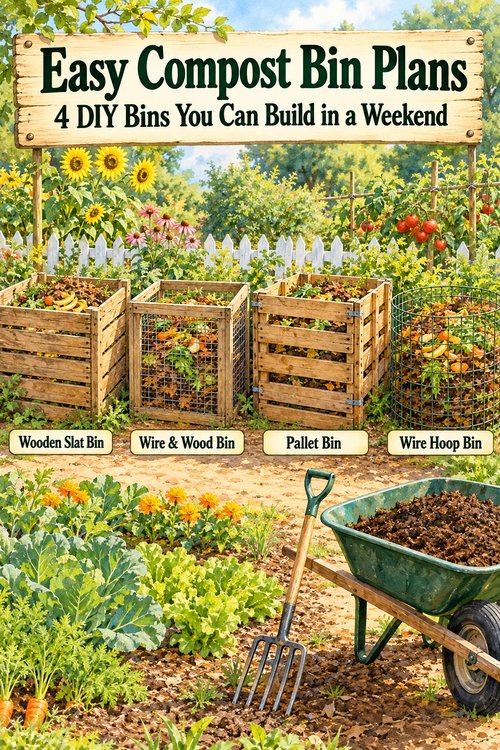
These free compost bin plans show you how to build four easy bins at home, from a simple wire hoop to a sturdy wooden bin.
Each one turns kitchen scraps and yard waste into rich compost for your vegetable garden.
Our compost pile has given us some fun surprises over the years. One summer, an amazing squash plant sprouted right out of the compost. It turned out to be a hybrid, and the squash were delicious!
Another time, a friend gave me a little avocado plant she found growing at the edge of her compost pile. It's now growing in a pot on our kitchen counter.
Composting is a good and rewarding endeavor.
All four compost bin plans can be built in a weekend with basic tools, and most can use recycled or free materials to keep costs down.
Soil, Fertilizer and Composting — complete hub for building rich vegetable garden soil through composting, fertilizing, mulching, and manure
How to Choose Compost Bin Plans
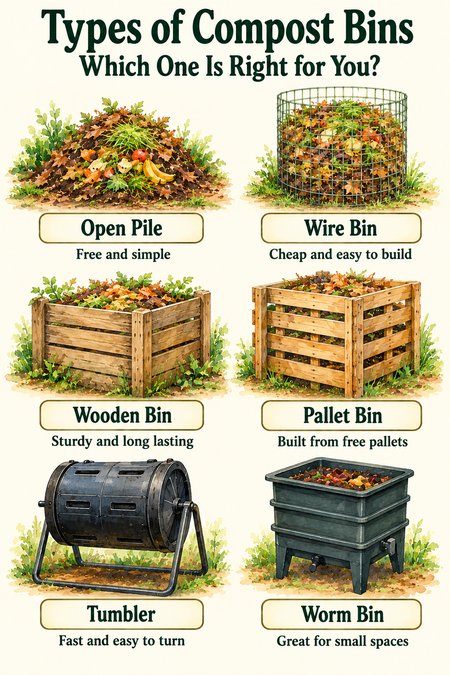
The best compost bin is the one that fits your space, your budget, and how much yard waste you have. Before you build using our compost bin plans, keep these four things in mind.
- Size. Build it at least 3 feet wide, 3 feet deep, and 3 feet tall. A pile that size holds enough heat to break down quickly. Bigger than about 5 feet on a side, and air can't reach the middle.
- Location. Pick a level, well-drained spot in part shade, close to the garden and within reach of a hose. Full sun dries a pile out; deep shade keeps it cold.
- One bin or two? One bin is plenty to start. With two or three, one pile can finish while you fill the next.
- Critters. If mice or rats are a problem, lay ½-inch hardware cloth under the bin, and keep meat, dairy, and oily food scraps out of the pile.
Plan 1: Wooden Slat Compost Bin
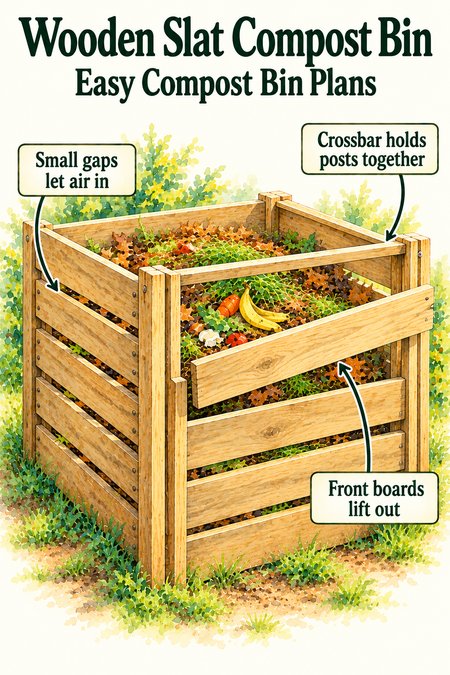
This sturdy one-bin design holds a full-size pile. The front boards slide out one at a time, so you can turn the pile or scoop out finished compost from the bottom. Build it on level ground. Untreated wood or cedar is best, and cedar lasts the longest.
Finished size: about 4 feet wide, 4 feet deep, and 3 feet tall.
Materials
- 6 posts of 2x2 lumber, each 3 feet 6 inches long
- 1 piece of 2x2 lumber, about 4 feet 9 inches long, for the top crossbar
- 24 boards of 1x6 lumber, each 4 feet long
- 96 galvanized wood screws, No. 10, 1½ inches long
- 4 galvanized wood screws, No. 10, 2½ inches long
Tools
- Hammer or mallet, hatchet or handsaw, power drill with a 1/8-inch bit, and a tape measure
How to Build It
- Set the corner posts. Shave one end of each 2x2 post to a point. Pound four of them 6 inches into the ground at the corners, 4 feet apart from front to back and 3 feet 10½ inches apart from side to side.
- Make the front slots. Pound the last two posts in just inside the two front corner posts, leaving a 1-inch gap between each pair. The loose front boards will slide down into these slots.
- Attach the sides. Starting at the bottom, screw six 1x6 boards to each side, leaving a ½-inch gap between boards for air. Drill small pilot holes first, and use two 1½-inch screws at each post.
- Attach the back. Screw six more boards across the back the same way.
- Slide in the front. Drop the last six boards into the front slots. Don't screw them in, so they lift out as the pile grows or when it's time to empty the bin.
- Add the crossbar. Cut two 3-inch blocks from leftover 2x2. Screw one under each end of the long crossbar with the 2½-inch screws (drill pilot holes first), then set the crossbar across the tops of the front posts. It keeps the front posts from spreading apart.
Plan 2: Wire and Wood Mobile Compost Bin
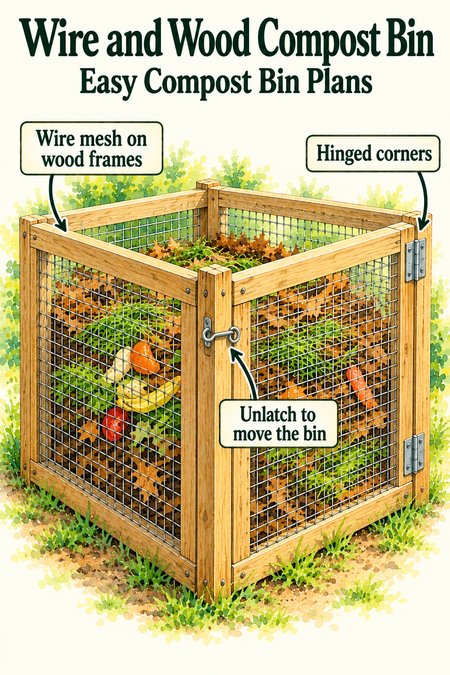
This bin is made of four framed wire panels, hinged in pairs and latched at the corners. When it's time to turn the pile, unlatch it, lift it off, set it up beside the pile, and fork the pile back in. The finished compost on the bottom is left behind, ready to use.
Finished size: about 3 feet wide, 3 feet deep, and 3 feet tall.
Materials
- 12 feet of ½-inch hardware cloth, 36 inches wide
- 4 pieces of 2x4 lumber, each 12 feet long
- About 100 galvanized wood screws, No. 8, 1½ inches long
- 4 door hinges, 3 inches, with screws
- 4 hook-and-eye latches
- Carpenter's wood glue and heavy-duty staples
Tools
- Circular saw or table saw, tin snips, power drill with a 1/8-inch bit, and a staple gun
How to Build It
- Cut the frame pieces. Cut each 12-foot 2x4 into four 3-foot pieces, for 16 pieces in all.
- Cut the lap joints. At both ends of every piece, cut a notch 3½ inches long and ¾ inch deep (half the thickness of the board). Cut all the notches on the same face. Set the saw blade to ¾ inch and make several passes until the wood is cleared out.
- Build four frames. Fit the notched ends together to make four 3-foot square frames. Glue each joint, drill pilot holes, and screw it together.
- Add the wire. Cut the hardware cloth into four 3-foot squares with tin snips. Fold the cut edges back about an inch for strength. Center a square on each frame and staple it every 4 inches, pulling it tight so it won't sag when the bin is full.
- Hinge and latch. Join the frames in pairs with two hinges each, making two L-shaped sections. Stand them up to form a square, and fasten the two open corners with the hook-and-eye latches.
Plan 3: Pallet Compost Bin
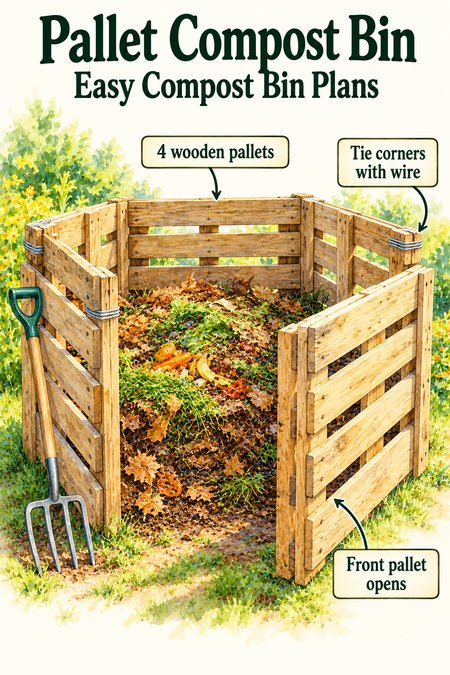
The cheapest bin of all our compost bin plans. Many feed stores, hardware stores, and lumber yards give away used pallets. A standard pallet makes a bin about 4 feet wide and 3½ feet tall.
Choose safe pallets: look for the stamp HT (heat-treated). Skip pallets stamped MB (treated with a chemical), and skip painted or stained ones.
Materials
- 4 wooden pallets about the same size
- Heavy wire, strong zip ties, or 3-inch screws
- Optional: chicken wire or hardware cloth to line the inside
How to Build It
- Set up the back and sides. On level ground, stand one pallet on edge for the back. Stand two more at right angles for the sides, making a U shape.
- Tie the corners. Fasten each back corner with wire or zip ties at the top, middle, and bottom, or screw the pallets together.
- Add the front gate. Tie the fourth pallet to one side with two loose wire loops, so it swings open like a gate. Close the other side with a wire loop you can lift off.
- Line it if needed. If the pallet boards are far apart, staple chicken wire or hardware cloth inside so leaves and scraps don't fall out.
Plan 4: Wire Hoop Compost Bin
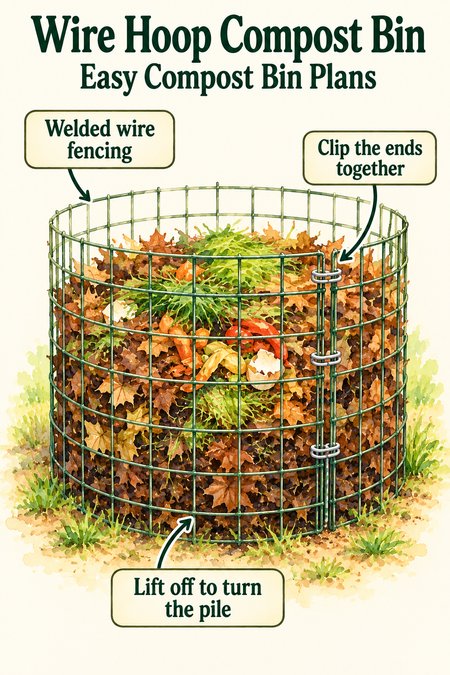
The easiest bin to build, and it takes about 15 minutes. It's perfect for fall leaves, and it's the easiest of our compost bin plans to turn: just lift it off the pile.
Materials
- 10 to 12 feet of welded wire fencing or hardware cloth, 36 or 48 inches tall
- 3 or 4 metal clips, heavy wire, or strong zip ties
- Optional: 2 metal garden stakes to keep it from tipping
Tools
- Wire cutters and work gloves (cut wire ends are sharp)
How to Build It
- Cut the wire. Unroll the fencing and cut a 10- to 12-foot length. That makes a circle about 3 to 4 feet across.
- Make the hoop. Bend it into a circle, overlap the ends about 6 inches, and fasten them with clips or wire from top to bottom.
- Set it in place. Stand the hoop on level ground. In a windy spot, push two stakes inside the wire to hold it steady.
- Turn the pile. When it's time, unclip or lift the hoop off, set it up right beside the pile, and fork everything back in. The pile gets mixed and fluffed in one easy step.
What to Put in Your Compost Bin
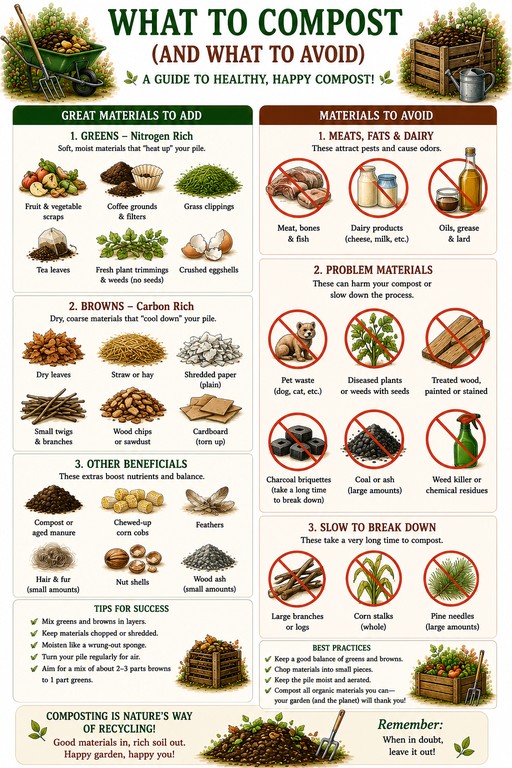
A good pile is a mix of "greens" like kitchen scraps and grass clippings, and "browns" like dry leaves and straw. Use about two to three parts browns for every one part greens, and keep the pile about as moist as a wrung-out sponge.
Compost Bin Questions
How long does it take to make compost?
A pile you turn every week or two can be ready in 2 to 3 months. A pile you leave alone still turns into compost, but it takes 6 months to a year.
Does a compost bin need a bottom?
No. Set it right on the soil so worms and other helpers can move in. If mice or rats are a problem, lay ½-inch hardware cloth under it.
Why does my compost smell bad?
A sour or rotten smell means the pile is too wet or has too many greens. Mix in dry leaves or straw and turn it to let air in.
How do I know when compost is ready?
Finished compost is dark, crumbly, and smells like fresh earth. You shouldn't be able to recognize the leaves or scraps you put in.
More Ways to Build Rich Garden Soil
Learn how to use horse manure compost, brew compost tea for your plants, or see our complete guide to vegetable garden soil.
For more on choosing a composting system and fixing common problems, see Oregon State University Extension's guide, Do the Rot Thing.
Recent Articles


-
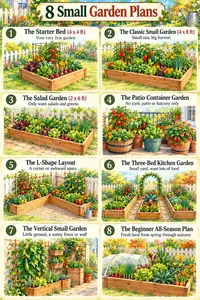
Small Vegetable Garden Plans: 8 Layouts That Maximise Space
Oct 08, 26 10:41 AM
 Small vegetable garden plans are some of the most searched and most valuable resources in home food growing.
 -
USDA Zone Finder - Find Your Vegetable Planting Dates | Vegetable-Gardening-Online.com
Oct 07, 26 03:53 PM
 Find your USDA hardiness zone, last spring frost date, and first fall frost date by state and region. Free interactive zone finder from Vegetable-Gardening-Online.com.
 -
Interactive Vegetable Garden Planner | Vegetable Gardening Online
Oct 07, 26 02:29 PM
Design a vegetable garden with correctly scaled plant spacing, companion flowers, drag-and-drop placement, and a printable plan. -
Free Printable Garden Stationery: Gardening Letter Paper & Note Cards
Oct 07, 26 12:48 PM
Free printable garden stationery: watercolor letter paper, lined and unlined, plus folded note cards with garden, fall, and Christmas scenes. Print at home. -
Free Preschool Vegetable Garden Cut and Paste Activities
Oct 07, 26 12:43 PM
 Free preschool vegetable garden cut and paste activities for ages 3-4. Build your own backyard, container, or seed packet garden scene, and sticker sheets.
 -
Planning a Vegetable Garden: Layouts, Raised Beds, Containers & More
Oct 06, 26 07:44 PM
 Planning a vegetable garden? Start here: layouts, raised beds, containers, square foot gardening, free planning tools, and tips to avoid beginner mistakes.
 -
How to Start a Vegetable Garden: 10 Easy Steps for Beginners
Oct 06, 26 04:38 PM
 How to start a vegetable garden in 10 easy steps: pick a sunny spot, choose raised beds or containers, prepare the soil, and grow easy vegetables.